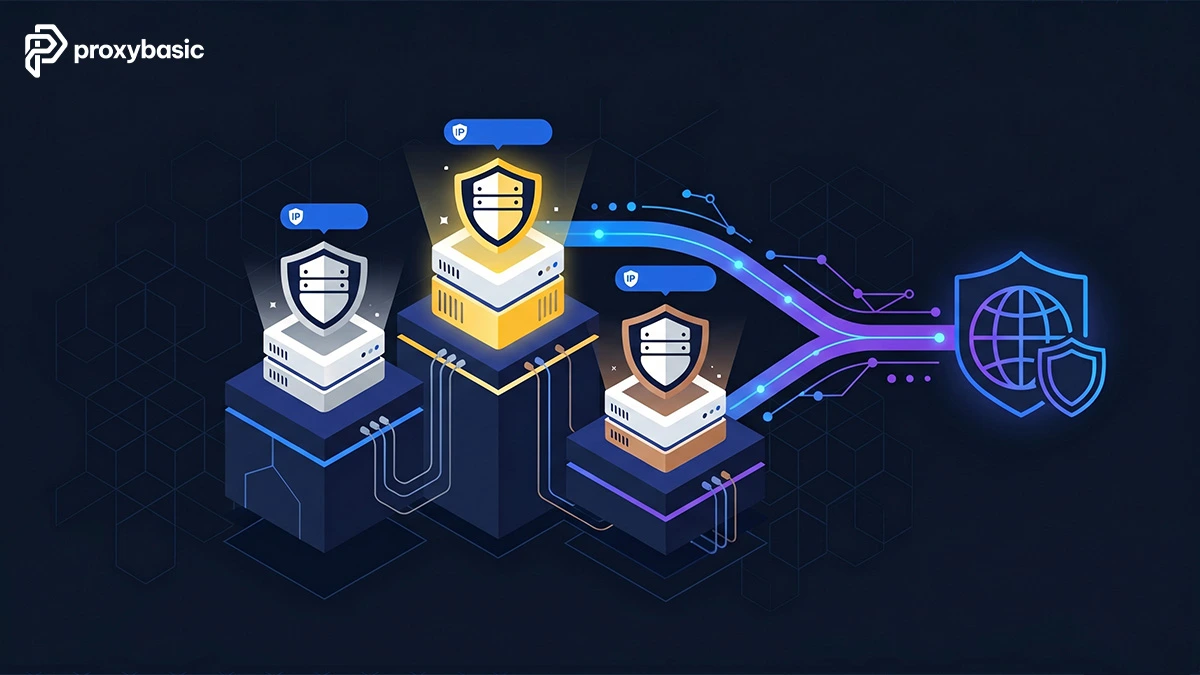
The 7 best residential proxy providers in 2026 are ScrapFly, Oxylabs, Bright Data, Smartproxy, Roundproxies, NodeMaven, and Zyte. While all offer access to genuine consumer IP addresses, they differ drastically in pool size, price per GB, and their ability to bypass modern anti-bot shields like Cloudflare or DataDome.
Choosing the right service depends on your specific technical requirements: do you need the massive 190M+ IP reach of an enterprise giant, or the cost-efficiency of non-expiring traffic for a smaller operation?
What Is a Residential Proxy Service and Why Do You Need One?
The core advantage of a residential proxy service is legitimacy. By routing traffic through real home devices assigned by ISPs (like Comcast or BT), your requests appear as genuine human traffic. Unlike datacenter proxies, which are easily flagged due to their server-farm origins, residential IPs carry clean histories and low abuse scores, leading to significantly higher success rates for scraping and automation.
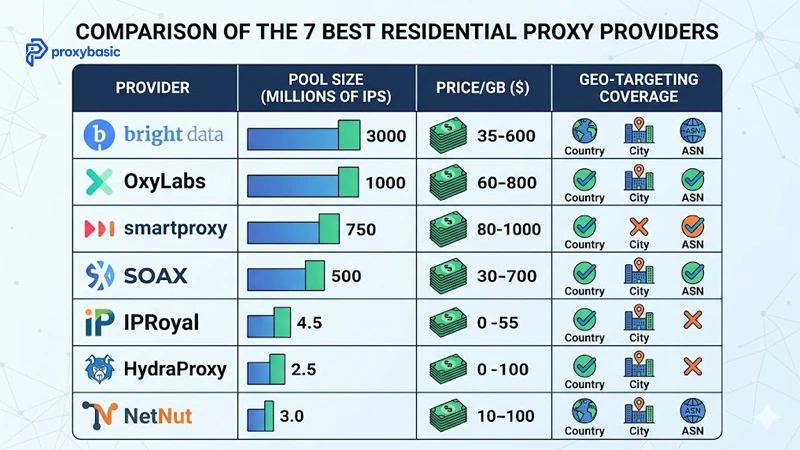
Below is a comprehensive breakdown of the top providers, compared across five performance-critical criteria: pool size, pricing models, geo-targeting depth, session control, and anti-bot capabilities.
What Types of Residential Proxies Do Providers Offer?
There are 3 main types of residential proxies that providers offer, classified by session behavior and IP source: rotating residential, static residential (ISP proxies), and mobile proxies.
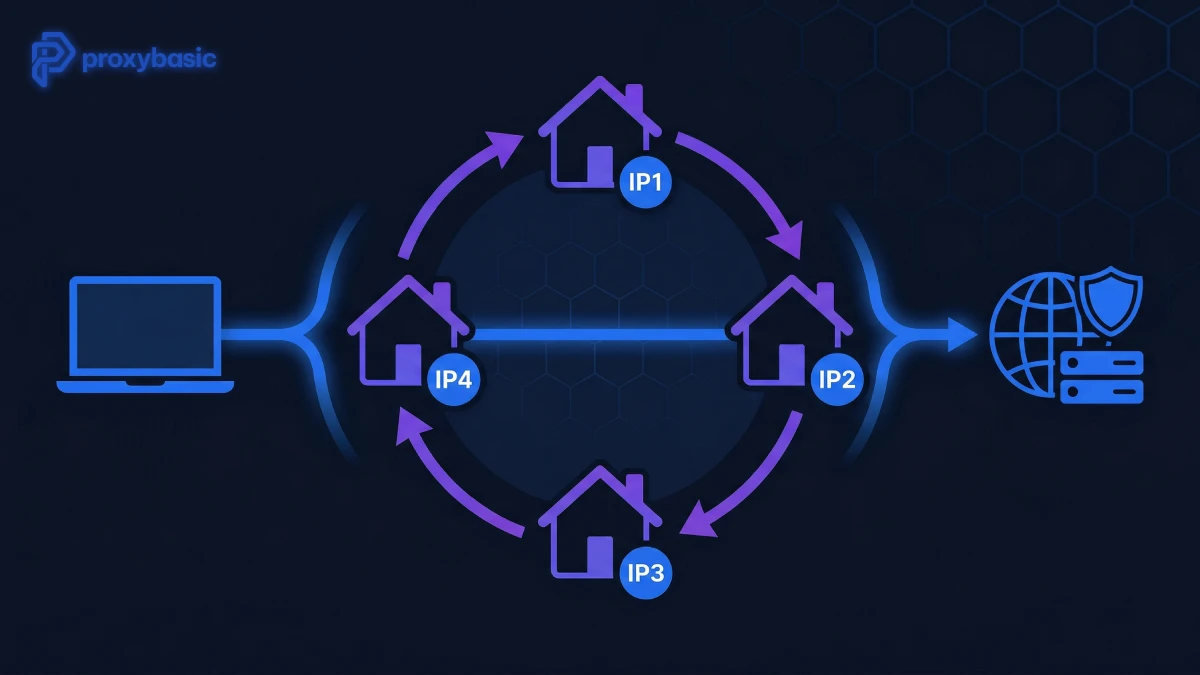
Rotating residential proxies assign a new IP address on each request or at set intervals. This type works best for large-scale web scraping, price monitoring, and SERP tracking where you need a fresh identity per request to avoid IP-level blocks.
Static residential proxies, also called ISP proxies, keep the same IP address for an extended session. These are better suited for login-based scraping, account management, and any workflow that needs a persistent identity over time. Providers source these IPs directly from ISPs and host them on server infrastructure, which gives them the stability of a datacenter proxy with the legitimacy of a residential IP.
Mobile proxies route traffic through real mobile carrier IPs on 4G or 5G networks. They carry the highest trust scores of the three types because mobile IPs rotate naturally through carrier infrastructure, but they also cost significantly more per GB.
What Scraping and Business Use Cases Require Residential Proxies?
There are 6 primary use cases that require residential proxies over datacenter alternatives: web scraping protected targets, price monitoring, SEO rank tracking, ad verification, sneaker and limited-item purchasing, and social media management.
- Web scraping protected targets: Any site running Cloudflare, Akamai Bot Manager, or DataDome will block datacenter IPs on sight. Residential proxies lower the bot score enough to get through without CAPTCHA walls on most targets.
- Price monitoring: Retail and travel sites actively block scrapers to prevent competitor price intelligence. Residential IPs let monitoring tools pull accurate pricing data across multiple regions without triggering blocks.
- SEO rank tracking: Search engines return different results by location. Residential proxies with city-level geo-targeting let SEO teams pull localized SERPs accurately.
- Ad verification: Ad fraud detection requires checking what ads appear in specific locations. Residential IPs in the target region make this possible.
- Sneaker and limited-item purchasing: Checkout systems on Nike, Adidas, and similar sites use bot detection that filters datacenter IPs. Residential proxies are the standard tool for this use case.
- Social media management: Platforms like Instagram and LinkedIn flag account activity from datacenter IPs. Residential proxies keep automation tools running without account bans.
According to April 2026 industry benchmarks covering over 5 million connection requests across high-security e-commerce and search targets, top-tier residential proxies achieved an average success rate of 98.4% to 99.8%.
Which Are the 7 Best Residential Proxy Providers to Buy in 2026?
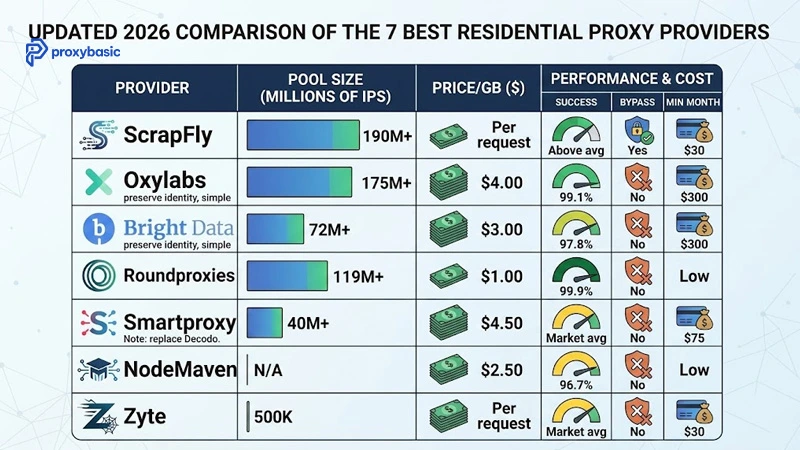
The 7 best residential proxy providers to buy in 2026 are ScrapFly, Oxylabs, Bright Data, Smartproxy, Roundproxies, NodeMaven, and Zyte, ranked across pool size, price per GB, success rate, anti-bot capabilities, and minimum monthly commitment.
The table below covers the full feature comparison across all 7 residential proxy services. Buyers should read this table alongside their use case and budget before committing to a provider.
| Provider | Pool Size | Price/GB | Success Rate | Anti-bot Bypass | Min. Monthly |
| ScrapFly | 190M | Per request | Above avg | Yes | $30 |
| Oxylabs | 175M | $4.00 | 99.1% | No | $300 |
| Bright Data | 72M | $3.00 | 97.8% | No | $300 |
| Roundproxies | 119M | $1.00 | 99.9% | No | Low |
| Smartproxy | 40M | $4.50 | Market avg | No | $75 |
| NodeMaven | N/A | $2.50 | 96.7% | No | Low |
| Zyte | 500K | Per request | Market avg | No | $30 |
We map these options against the criteria that matter most for web scraping and business automation. Use the success rate and price columns together to calculate the real cost per successful request for your specific project.
Which Residential Proxy Provider Is Best for Web Scraping at Scale?
ScrapFly wins on anti-bot bypass and cost at scale, Oxylabs wins on pool size and reliability for enterprise workloads, and Roundproxies wins on price per GB for medium to large projects.
ScrapFly functions as a web scraping API rather than a traditional proxy list. It handles fingerprinting, CAPTCHA solving, JavaScript rendering, and HTTP/2 upgrading in the same layer as proxy routing. For teams scraping anti-bot protected targets like social networks, e-commerce sites, or travel platforms, ScrapFly reduces the engineering overhead significantly. The credit-based model brings a 50GB equivalent project down to $100/month versus $600/month on Oxylabs.
Oxylabs is the better choice for teams that need maximum pool size (175M IPs), above-market reliability (99.1% success rate), and city-level geo-targeting for high-volume enterprise scraping. The $300 minimum monthly commitment and $4.00/GB pricing make it less accessible for smaller teams, but the performance data justifies the cost for large-scale operations.
Roundproxies recorded a 99.9% success rate on a 5,000-product Amazon DE scraping test run over 7 days, with no CAPTCHAs triggered. At $1.00/GB with the RP50 discount code and non-expiring traffic, it delivers the best price-to-performance ratio for teams running regular scraping operations without enterprise budgets.
Which Residential Proxy Service Offers the Best Price per GB?
Roundproxies offers the best price per GB at $1.00/GB (with the RP50 discount code), followed by NodeMaven at $2.50/GB and Bright Data at $3.00/GB.
The price difference between providers is large enough to change project budgets significantly. A 50GB/month scraping project costs:
- Roundproxies: ~$50/month (with discount)
- Bright Data: $150/month
- Smartproxy: $225/month
- Oxylabs: $200/month
Roundproxies’ non-expiring traffic adds another layer of value. Unused bandwidth carries forward to the next month, which means teams with irregular scraping schedules pay only for what they actually use rather than losing quota at month end.
One trade-off to note: lower-priced providers generally do not include anti-bot bypass, JavaScript rendering, or log monitoring dashboards. If your scraping targets require those features, the cost comparison shifts toward ScrapFly or Zyte despite their higher effective per-GB rate.
What Are the Best Residential Proxy Providers for Beginners with Small Budgets?
The 3 best residential proxy providers for beginners with small budgets are ScrapFly ($30/month minimum), Zyte ($30/month minimum), and Smartproxy ($75/month minimum), selected based on low entry cost, usable dashboards, and straightforward setup.
ScrapFly is the most beginner-accessible option because its API handles proxy rotation, fingerprinting, and anti-bot responses automatically. New users do not need to manage proxy lists, rotation logic, or CAPTCHA solving separately. The $30 minimum commitment covers roughly 300-500 successful requests depending on target complexity.
Zyte (formerly Scrapinghub) brings years of web scraping engineering experience to a smart proxy manager with per-request pricing. It matches the speed and reliability of larger providers while offering JavaScript rendering support. The dashboard is more developer-focused than ScrapFly, so some technical comfort helps.
Smartproxy works well for beginners who want a traditional rotating proxy setup with a clean dashboard and 240+ country coverage. The $75 minimum is low enough to test on a real project before scaling, and the setup process is well-documented with ready-made browser extensions and integrations.
What Are the Key Criteria to Compare Residential Proxy Providers?
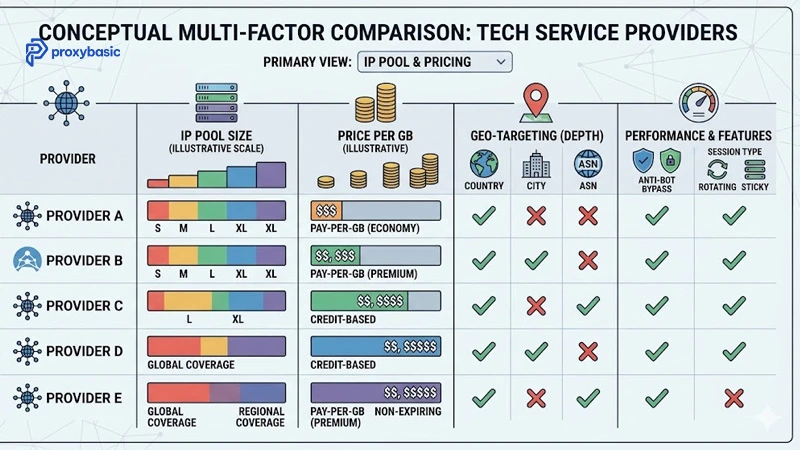
The 5 key criteria to compare residential proxy providers are: IP pool size, price per GB, geo-targeting depth, session type (rotating vs sticky), and anti-bot bypass capability. Each criterion affects a different part of your scraping or automation workflow.
Picking a provider based on price alone without checking pool size or geo coverage is the most common mistake buyers make. A cheap provider with a 5M IP pool will exhaust clean addresses quickly on high-volume projects, driving up your actual cost per successful request. The sections below break down each criterion with data from the top providers.
How Does IP Pool Size Impact Residential Proxy Performance?
Large IP pools are a mechanical necessity for high-volume projects. They ensure lower reuse rates per IP and prevent the behavioral profiling that triggers blocks on protected targets. While rotation logic determines the success of individual requests, pool size sets the ceiling for your overall scraping scale.
Pool size data across top residential proxy providers in 2026:
| Provider | Pool Size |
| ScrapFly | 190M IPs |
| Oxylabs | 175M IPs |
| SOAX | 155M IPs |
| Decodo | 115M IPs |
| Roundproxies | 119M IPs |
| Smartproxy | 40M IPs |
| Bright Data | 72M IPs |
This table covers pool size as the primary supply-side metric for each residential proxy service. Buyers running high-volume projects should use this data as a baseline filter before comparing pricing.
Pool size alone does not guarantee performance. A provider with 190M IPs but poor rotation logic will still produce more blocks than a provider with 40M IPs that rotates intelligently. Pool size sets the ceiling; rotation quality determines the floor.
How Should You Compare Residential Proxy Pricing Models Before You Buy?
Beyond the sticker price, the “real cost” of a residential proxy service is determined by your consumption patterns. Pay-per-GB remains the industry standard for predictability, but Credit-based and Non-expiring models offer significantly better ROI for specific workflows:
- Pay-per-GB (Oxylabs, Bright Data): Best for high-volume, predictable enterprise traffic.
- Credit-based (ScrapFly): Ideal for web scraping; you pay for successful requests regardless of HTML size, avoiding the “bandwidth tax” on heavy pages.
- Non-expiring (Roundproxies): Eliminates “use-it-or-lose-it” waste for teams with irregular scraping schedules.
Does Geo-targeting Quality Differ Between Residential Proxy Providers?
Yes, geo-targeting quality differs significantly between residential proxy providers, both in the number of countries available and the depth of targeting within those countries (country-level vs city-level vs ASN-level).
Country count alone does not capture the real difference. Smartproxy covers 240+ countries but only offers country and city-level targeting on a limited subset. Roundproxies supports ASN-level targeting on top of country and city selection, which gives scraping teams finer control over which ISP network their requests appear to come from. This matters for targets that check ASN in addition to IP reputation.
For localized SEO rank tracking or ad verification, city-level targeting is a minimum requirement. For scraping targets that use ASN-based filtering, ASN-level targeting from providers like Roundproxies or Oxylabs becomes necessary.
What Is the Difference Between Rotating and Sticky Residential Proxy Sessions?
Rotating sessions assign a new residential proxy IP per request or on a timed interval. Sticky sessions keep the same IP for an extended period, typically 1 to 30 minutes depending on the provider.
Rotating sessions are the right choice for: bulk scraping, price monitoring, SERP tracking, and any workflow where each request is independent and a fresh IP reduces the block risk.
Sticky sessions are the right choice for: login-based scraping, multi-step checkout automation, account management, and any workflow where the target site tracks session continuity. A site that sees your session switch IP mid-login will flag or block the session immediately.
Most top residential proxy providers support both modes. The practical difference shows up in how you configure your proxy endpoint: rotating proxies use a backconnect gateway that handles IP assignment automatically, while sticky sessions require you to specify a session ID in your proxy authentication string to maintain the same IP across requests.
What Advanced Features Separate the Top Residential Proxy Services from the Rest?
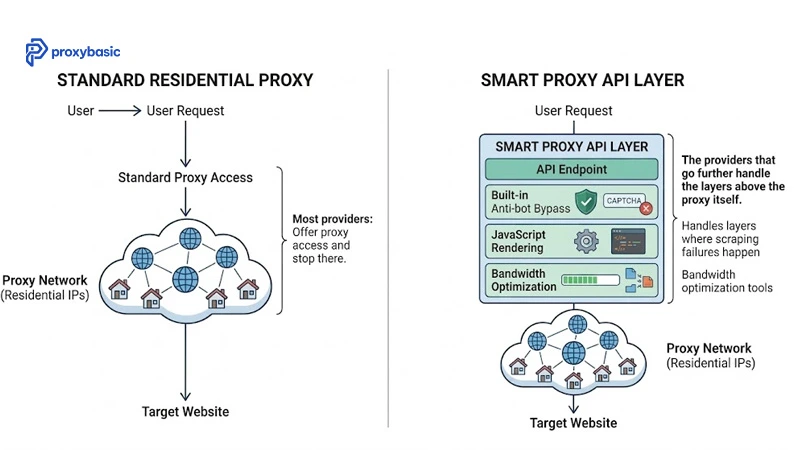
Two features separate the top residential proxy services from standard providers: built-in anti-bot bypass capability and bandwidth optimization tools. Most providers on the market offer proxy access and stop there. The providers that go further handle the layers above the proxy itself, which is where most scraping failures actually happen.
Does Anti-bot Bypass Capability Matter When Choosing a Residential Proxy Provider?
Yes, A clean residential IP is no longer a silver bullet. Modern anti-bot layers like Cloudflare and DataDome now analyze TLS fingerprints and JavaScript environments, meaning a “trusted” IP with a mismatched fingerprint will still trigger a CAPTCHA.
Among the top 7, ScrapFly is the only provider with a built-in Anti-bot Bypass layer that solves these challenges natively. For all other providers, including Oxylabs and Bright Data, your engineering team must manually manage headers, fingerprints, and CAPTCHA solving within your own scraping logic.
Can Blocking Non-critical Resources Reduce Your Residential Proxy Bandwidth Costs?
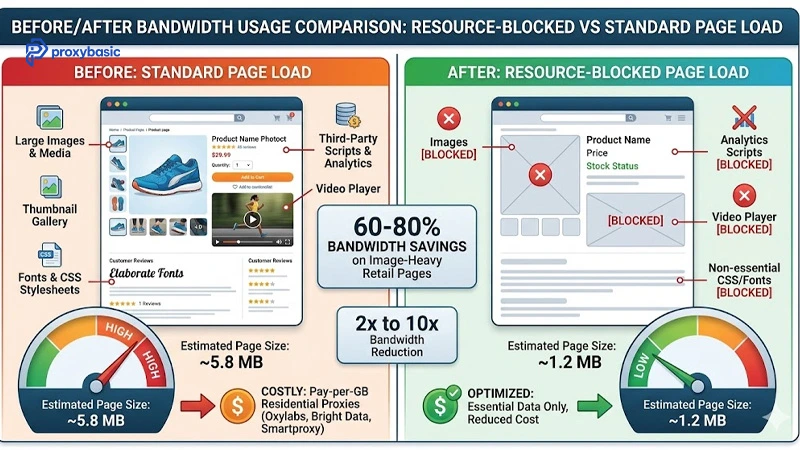
Yes, blocking non-critical resources in your scraping setup can reduce residential proxy bandwidth consumption by 2 to 10 times, depending on the target site and the types of assets it loads.
When you use browser automation tools like Puppeteer, Playwright, or Selenium, every page load also fetches images, fonts, stylesheets, analytics scripts, and video assets. None of these are needed for data extraction, but each one counts toward your bandwidth usage and adds latency to your requests.
Blocking these resources at the browser level keeps only the HTML and essential XHR/fetch requests that contain the data you need. On image-heavy retail pages, this alone can cut bandwidth usage by 60-80%. According to ScrapFly’s engineering documentation, blocking non-critical media resources is one of the most accessible cost optimization steps available to teams using pay-per-GB pricing models.
For teams on Oxylabs, Bright Data, or Smartproxy at $3-$4.50/GB, a 60% bandwidth reduction translates directly to a 60% reduction in monthly proxy costs without any change in data output.
FAQ
Which residential proxy provider is best for beginners?
For beginners, ScrapFly and Smartproxy are the easiest options because they offer simple dashboards, automatic IP rotation, and low entry pricing.
Are residential proxies better than datacenter proxies for web scraping?
Yes. Residential proxies use real ISP-assigned IP addresses, which makes them harder to detect and more effective against anti-bot systems like Cloudflare and DataDome.
What is the cheapest residential proxy provider in 2026?
Roundproxies offers the lowest pricing in this comparison at around $1.00/GB with non-expiring traffic, making it one of the most cost-efficient choices for regular scraping projects.
Conclusion: How to Choose the Right Residential Proxy Provider for Your Needs
The right residential proxy provider comes down to four variables: bandwidth volume, bot protection level of your targets, geo-targeting depth, and budget. ScrapFly fits teams scraping anti-bot protected sites at low to medium volume, Oxylabs suits high-volume enterprise workloads with its 175M IP pool and 99.1% success rate, and Roundproxies at $1.00/GB is the strongest choice for teams running regular projects on tighter budgets.
Beginners should start with ScrapFly or Smartproxy to learn rotation logic before moving to a raw proxy list setup. Teams already using Puppeteer, Playwright, or Selenium should apply resource blocking first, since that single change can cut bandwidth costs by 60% or more without touching your provider. For a full comparison of residential proxy services, residential proxy checker tools, and buy residential proxy guides by use case, visit ProxyBasic.