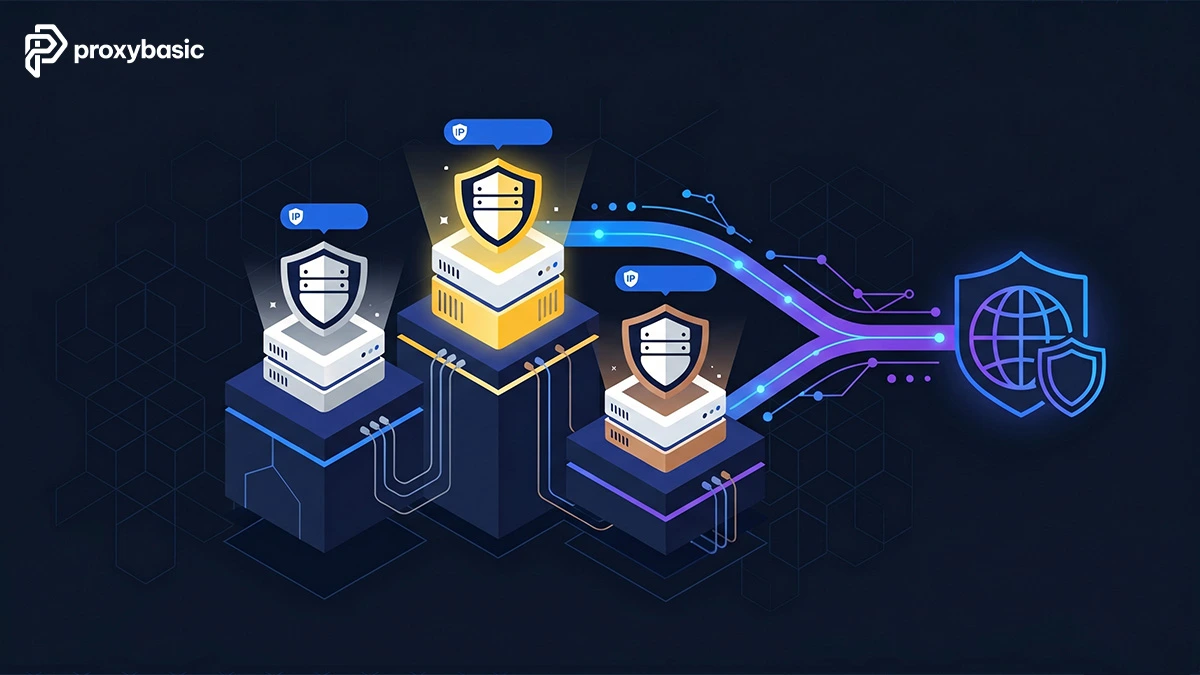
The best residential proxy API for web scraping in 2026 are Oxylabs, Bright Data, Decodo (formerly Smartproxy), Webshare, ScrapFly, and Zyte – each routes requests through real ISP-assigned IPs, rotates addresses automatically, and eliminates manual proxy list management. For a 50GB/month project, costs range from $122/month on the budget end to $1,000+ on the managed API end depending on your target sites.
Pricing models split into two camps: per-GB billing from Oxylabs, Decodo, and Webshare works well for high-volume text scraping where bandwidth is predictable, while per-request billing from ScrapFly and Zyte fits JavaScript-heavy targets where a single page load pulls dozens of sub-resources – picking the wrong model can mean paying 6x more than necessary.
Setup complexity also varies widely, from a single endpoint URL configurable in two lines of Python to form-based onboarding requiring whitelisted IPs before your first request clears. Below is a full breakdown of all six providers with updated 2026 pricing, Proxyway benchmark data, and working code examples to get rotating residential proxies running today.
What a Residential Proxy API Is and How It Works
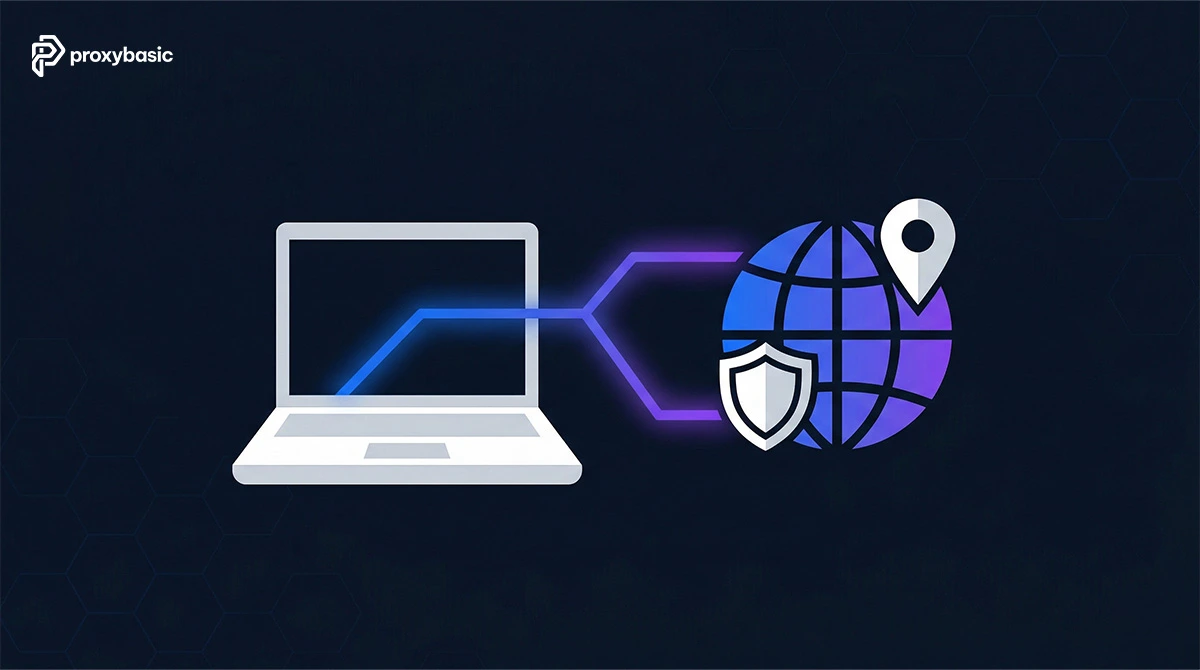
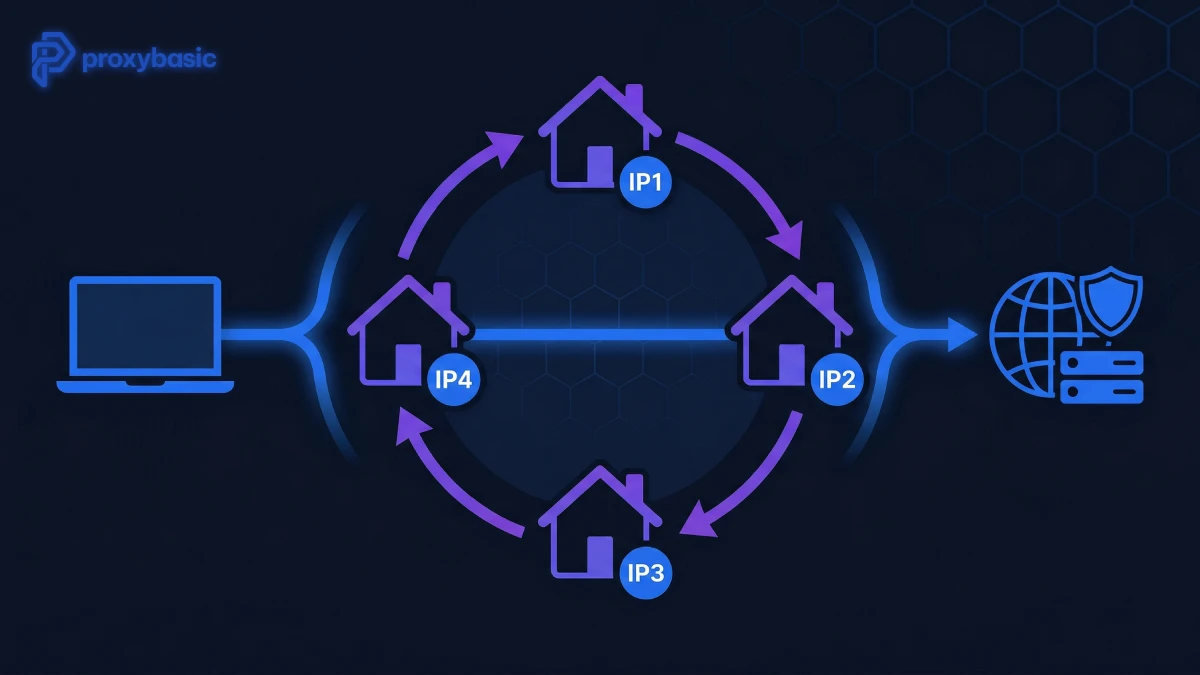
A residential proxy API is a programmable endpoint that routes HTTP requests through real ISP-assigned IP addresses, rotating them automatically per request or per session without requiring you to manage individual proxy IPs.
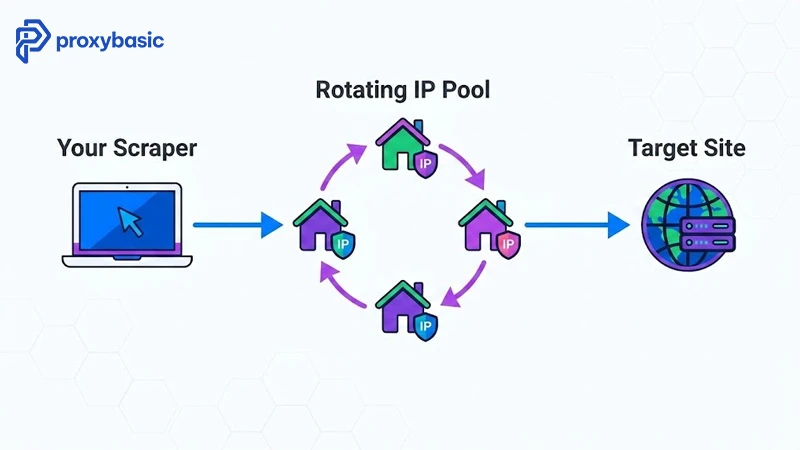
Here is how the request flow works at the technical level:
- You send your target URL to the residential proxy API endpoint along with credentials and optional parameters such as country, city, or session ID.
- The API selects a residential IP from its pool and forwards your request through it.
- The target website receives the request from what looks like a real home user’s connection.
- The API returns the response to your application.
- On the next request, a different IP from the pool is selected automatically.
The key difference from a traditional proxy list is a single endpoint URL instead of hundreds of IP:port combinations. There is no need to handle health checks, rotation logic, or failed IP replacement. The API layer handles all of that on the provider side.
Top 6 Residential Proxy API Providers Compared
The 6 best residential proxy API providers each lead on different criteria. Oxylabs leads on pool size and raw speed. Decodo wins on success rate and value. Bright Data offers the broadest product range. Webshare is the cheapest per-GB option. ScrapFly handles the hardest targets with built-in anti-bot bypass. Zyte tops independent scraping API benchmarks.
The table below covers every key metric across all 6 providers based on current 2026 pricing and Proxyway’s 2025 independent benchmark data.
| Feature | Oxylabs | Bright Data | Decodo | Webshare | ScrapFly | Zyte |
| Pool Size | 175M+ | 72M+ unique | 125M+ | 80M+ | 130M+ | Undisclosed |
| Countries | 195 | 195 | 195+ | 195 | 120+ | 200+ |
| Pricing Model | Per-GB | Per-GB / Per-req | Per-GB | Per-GB | Per-request | Per-request |
| Price per GB | $5.00 | $8.00 ($4 promo) | $4.90 | $4.90 ($2.45 promo) | Variable | Variable |
| Min. Plan | $30/mo | $0 PAYG | ~$55/mo | $3.50/mo | $30/mo | $0 PAYG |
| 50GB Est. Cost | ~$250/mo | ~$400/mo | ~$245/mo | ~$122-245/mo | $1,000+ | $105-960+ |
| Anti-Bot Bypass | Web Unblocker (add-on) | Web Unlocker (add-on) | Site Unblocker (built-in) | None | Built-in | Built-in |
| JS Rendering | Headless Browser | Scraping Browser | Via API | None | Built-in | Instant Browsers |
| Success Rate | 99.82% | ~99.17% | 99.86% | N/A | N/A | 93.14% (API) |
| Avg Response Time | 0.41s | N/A | 0.63s | N/A | N/A | N/A |
| Free Trial | 3-7 days | $25-50 credits | 3 days / 100MB | 10 DC proxies free | 1,000 credits | $5 credit |
Oxylabs
Oxylabs offers a classic rotating endpoint with the largest verified residential pool at 175M+ IPs across 195 countries and the fastest average response time in Proxyway’s 2025 benchmark at 0.41 seconds. Its 99.82% success rate ranks second only to Decodo in the same test.
At $5/GB on the Basic plan with a $30/month entry point, a 50GB project costs approximately $250/month. Anti-bot bypass and JavaScript rendering are available as separate products rather than bundled into the standard residential proxy API. Onboarding requires a form submission rather than instant self-service signup.
Best for: enterprise teams running large-volume scraping jobs who need maximum pool size and reliability.
Bright Data
Bright Data holds the widest product catalog of any provider on this list. Beyond a 72M+ unique residential IP pool, it offers a Web Unlocker, Scraping Browser, Web Archive with 50+ petabytes of historical data, and an Agent Browser. Their pool marketing shifted in 2025 to “400M+ monthly rotating IPs” counting unique addresses seen across the full month rather than concurrently available IPs.
Standard pricing is $8/GB, the highest rate on this list, though an active 50% promotional code cuts that to $4/GB for the first three months. PAYG access starts at $0 with no minimum commitment. Bright Data crossed $300M in annual recurring revenue in 2025 with AI infrastructure customers driving growth.
Best for: teams needing a broad product range beyond raw proxies, or access to historical web data for AI training pipelines.
Decodo (formerly Smartproxy)
Decodo rebranded from Smartproxy on April 22, 2025 alongside product expansions that added a Universal Scraper, AI-powered parser, and n8n workflow integration. The residential pool grew from 65M to 125M+ IPs as part of the rebrand. In Proxyway’s 2025 benchmark covering over 2 million test requests across 21 days, Decodo posted the highest residential proxy success rate at 99.86% and earned a “Best Value” designation.
At $4.90/GB with plans starting around $55/month, a 50GB project costs approximately $245/month. The Site Unblocker is built into the product rather than sold separately. Sticky sessions extend up to 30 minutes.
Best for: mid-size projects that need a strong balance of success rate, broad geo-coverage, and built-in unblocking without a separate product purchase.
Webshare
Webshare is the only provider with a permanently free tier: 10 datacenter proxies at no cost and no expiry. Following its acquisition by Oxylabs, the residential pool grew from 30M IPs in 50 countries to 80M+ IPs across 195 countries. Standard pricing is $4.90/GB with a current 50% promotion bringing it to $2.45/GB, making a 50GB project $122-245/month.
Webshare has no anti-bot bypass, no JavaScript rendering, and no scraping API. What it provides is a clean rotating endpoint, a log monitoring dashboard, and the lowest per-GB rate on this list for paid plans. It also offers ISP (static residential) proxies with unlimited bandwidth at a flat monthly rate for account management tasks.
Best for: developers who want free proxy testing before spending, or projects scraping unprotected sites at the lowest possible per-GB cost.
ScrapFly
ScrapFly operates as smart proxy middleware. You send a target URL to ScrapFly’s API and receive the scraped content back, with proxy rotation, CAPTCHA solving, JavaScript rendering, and fingerprint management handled in a single request. The residential proxy API plan starts at $30/month for 200,000 credits.
At 25 credits per standard request, a 50GB project equivalent scales to estimated $1,000+ per month at full volume. However, ScrapFly’s Proxy Saver product, which runs as middleware on top of your existing proxies to block non-critical resources and cache repeated requests, costs only $0.20/GB. The pool spans 130M+ IPs across 120+ countries.
Best for: teams scraping bot-protected targets who want anti-bot bypass, CAPTCHA solving, and JS rendering managed in one API call without separate services.
Zyte
Zyte’s API topped Proxyway’s 2025 Web Scraping API benchmark with a 93.14% success rate at 2 requests/second across 15 protected websites. Instant Browsers handle JavaScript rendering natively, and direct Scrapy integration makes it the default pick for Python/Scrapy stacks.
Pricing uses a tiered system by target difficulty. Simple targets can cost as low as $105/month for 500,000 pages. Complex targets with browser rendering on protected sites can push costs to $960+/month for the same volume. The $0 PAYG option with $5 in free credit allows immediate testing without any commitment.
Best for: Scrapy-based projects, Python developers who want a fully managed scraping outcome on difficult targets, and teams where success rate matters more than cost predictability.
Residential Proxy API vs Proxy Lists: Key Differences for Web Scraping
Residential proxy API beat proxy lists for web scraping on three points: automatic rotation with no dead IP management, built-in session control, and zero configuration changes needed when scaling up.
With a proxy list, you handle which IPs are still live, build rotation logic in your code, and replace banned addresses manually. On a large project this overhead compounds quickly. A residential proxy API offloads all of that to the provider.
Specific advantages over proxy lists:
- No dead IP overhead. Providers monitor pool health continuously and pull blocked IPs. You never send a request through a dead proxy.
- One-line integration. A single endpoint works across all scrapers. Switching providers means updating one string, not rewriting rotation logic.
- Built-in sticky sessions. Most APIs support session pinning via a parameter in the URL. No custom session management needed.
- Clean scaling. More concurrent requests means increasing your plan, not buying and configuring additional IPs.
The main tradeoff is cost. Because traffic routes through real residential devices, prices run higher than datacenter proxies at $3 to $15 per GB for standard plans. For targets with no anti-bot protection, datacenter proxies remain faster and cheaper. The residential proxy API pays for itself on sites that actively block datacenter IP ranges.
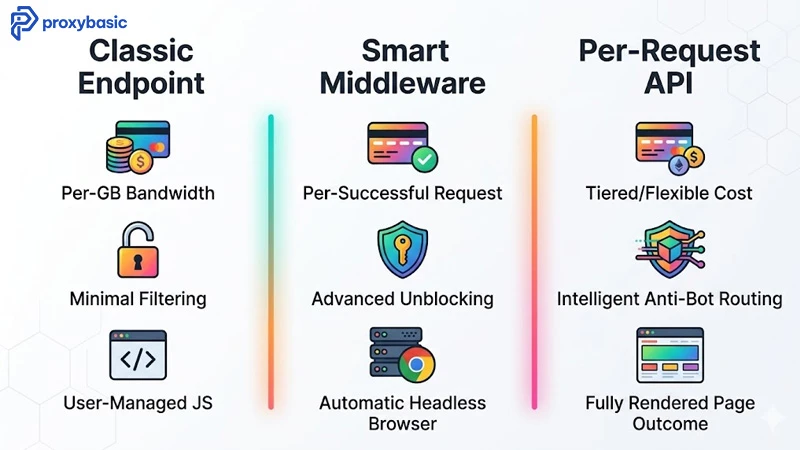
3 Types of Residential Proxy APIs
There are 3 main types of residential proxy APIs grouped by architecture: classic rotating endpoint, smart proxy middleware, and per-request scraping API. Knowing the type before choosing a provider prevents paying for features a project does not need.
Classic Rotating Endpoint
Providers such as Oxylabs, Bright Data, Decodo, and Webshare give you a standard proxy endpoint in host:port format with credentials. You configure it in your HTTP client the same way as any proxy. Rotation happens per request by default. This type works with any language and any HTTP library.
Smart Proxy Middleware
ScrapFly sits in this category. Instead of a raw proxy endpoint, you send requests to an API wrapping your target URL. The middleware handles proxy selection, CAPTCHA solving, JavaScript rendering, and fingerprint management in one request. Billing is per successful request rather than per GB of bandwidth transferred.
Per-Request Scraping API
Zyte’s API uses per-request pricing similar to ScrapFly but focuses on intelligent routing with tiered cost by target difficulty. It integrates directly with Scrapy and supports JavaScript rendering via Instant Browsers. This type works best for teams already in the Scrapy ecosystem or those who want a fully managed scraping outcome rather than raw proxy access.
Residential Proxy API Setup Guide: Python, cURL, and Java Examples
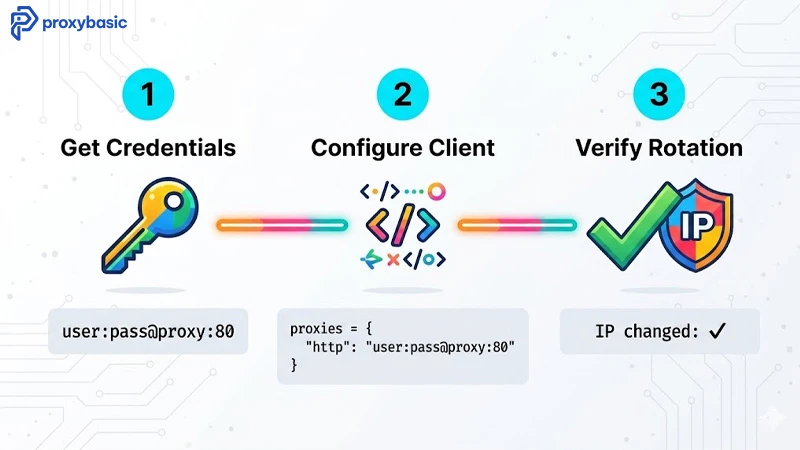
Connecting to a residential proxy API takes 3 steps: get endpoint credentials from the provider dashboard, configure the proxy in your HTTP client, and verify rotation with an IP-check request.
The examples below use Webshare’s rotating endpoint format. The same pattern applies to Oxylabs, Bright Data, and Decodo. Swap in your provider’s host, port, username, and password.
cURL
curl --proxy "http://username-rotate:[email protected]:80/" https://ipv4.webshare.io/
Python (requests)
import requests

proxies = {
    "http": "http://username-rotate:[email protected]:80/",
    "https": "http://username-rotate:[email protected]:80/"
}
response = requests.get("https://ipv4.webshare.io/", proxies=proxies)
print(response.text)
ScrapFly (smart proxy API format)
import requests

response = requests.get(
    "https://api.scrapfly.io/scrape",
    params={
        "key": "YOUR_API_KEY",
        "url": "https://target-website.com",
        "proxy_pool": "public_residential_pool",
        "country": "us"
    }
)
print(response.json()["result"]["content"])
To verify rotation is working, call https://ipv4.webshare.io/ or https://httpbin.org/ip multiple times and confirm the returned IP changes between requests. For sticky sessions, append a session ID to the username: username-rotate-session-abc123. The API returns the same IP for all requests sharing that session ID until it expires.
6 Criteria for Choosing the Right Residential Proxy API
Choosing the right residential proxy API depends on 6 criteria: pool size, anti-bot capability, pricing model, geo-targeting depth, minimum commitment, and JavaScript rendering support.
Pool size. Larger pools reduce IP reuse on the same target. For aggressive scraping of popular sites, 30M+ IPs is the practical floor. Oxylabs at 175M+ and Decodo at 125M+ lead here. Zyte’s pool is undisclosed but its smaller scale limits reliability at high concurrency on heavily scraped targets.
Anti-bot capability. Only ScrapFly and Zyte include anti-bot bypass natively in their residential proxy API. Oxylabs, Bright Data, and Decodo offer it as a separate product. Webshare has none. If your targets use Cloudflare, Akamai, or similar systems, factor in the cost of a standalone CAPTCHA-solving service when comparing per-GB providers.
Pricing model. Per-GB billing at $4.90 to $8.00/GB fits predictable text scraping. Per-request billing from ScrapFly and Zyte fits JavaScript-heavy targets where bandwidth per page is unpredictable. Per-GB billing on a JS-rendered site can cost 10x more than per-request billing for the same number of pages.
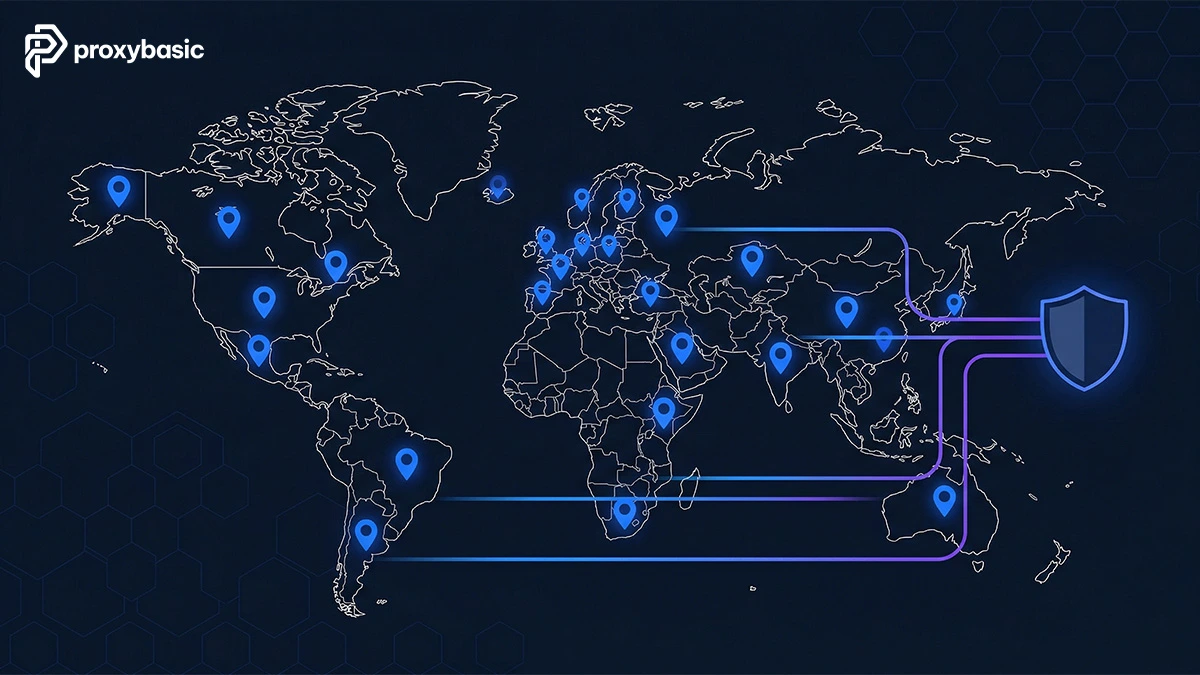
Geo-targeting depth. Decodo covers 195+ countries with the widest range. Oxylabs and Bright Data support city-level and ASN-level targeting in 195 countries. ScrapFly covers 120+ countries, which can limit localized scraping needs in smaller markets.
Minimum commitment. Bright Data, Zyte, and Webshare offer PAYG with no monthly minimum. ScrapFly and Oxylabs start at $30/month. Decodo starts around $55/month. Per-request providers with PAYG are easiest to trial without financial commitment.
JavaScript rendering. Only ScrapFly and Zyte include JS rendering natively. For targets that load content via JavaScript, all per-GB providers require a separate headless browser setup such as Puppeteer, Playwright, or Selenium on top of the proxy, which multiplies bandwidth usage per page.
FAQ
Why do web scrapers use residential proxy APIs?
Residential proxy APIs help avoid IP bans by routing traffic through real residential IP addresses instead of datacenter servers.
What is the difference between rotating and sticky sessions?
Rotating sessions change the IP on every request, while sticky sessions keep the same IP for a set period.
Are residential proxy APIs better than proxy lists?
Yes. Residential proxy APIs automate rotation, IP replacement, and session management without maintaining large proxy lists manually.
Conclusion
Residential proxy API handle the main friction point in web scraping: IP management and rotation without building custom infrastructure. With one endpoint, a scraper gets automatic rotation, session control, and geo-targeting out of the box.
Start with the free tier or trial that matches your stack. Test rotation, sticky sessions, and geo-targeting against your actual target before committing to a paid plan. The right residential proxy API becomes clear fast once you see real success rates on your specific use case. For more proxy comparisons, residential IP guides, and web scraping tools, visit ProxyBasic.