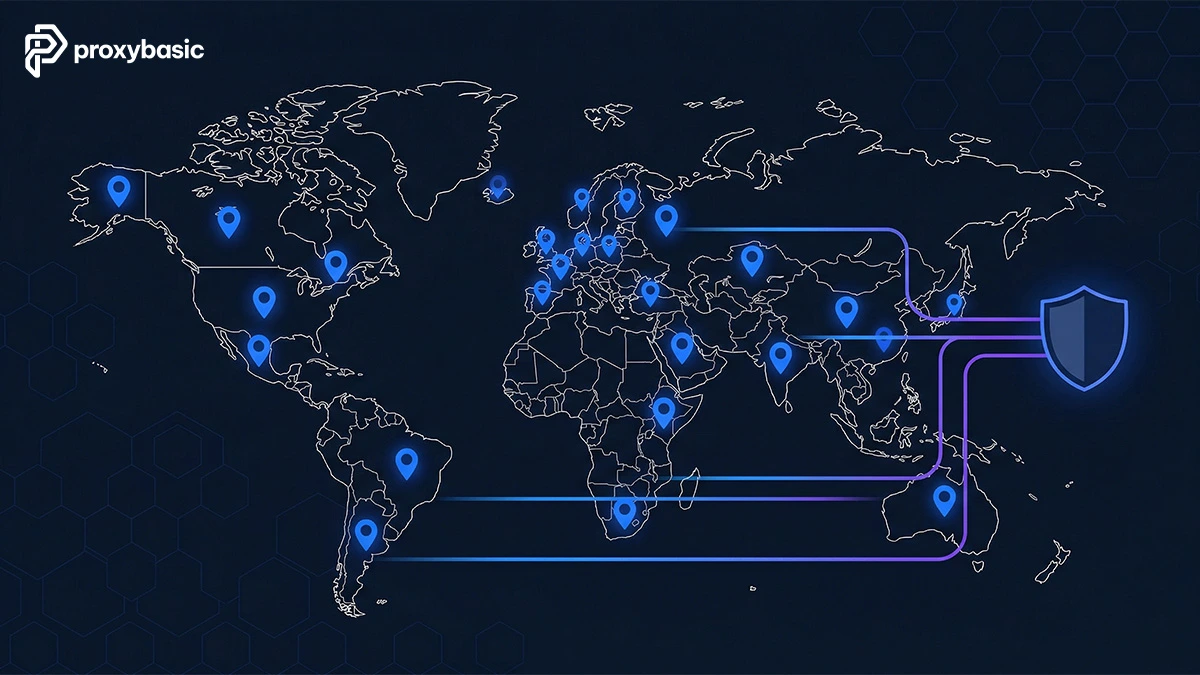
The 6 best static residential proxies in 2026 are Decodo, Oxylabs, Bright Data, IPRoyal, NetNut, and Webshare, each built for a different operational need. Decodo leads on affordability for dedicated ISP IPs, Oxylabs on enterprise-grade speed and uptime, Bright Data on location depth across 50+ countries, IPRoyal on the lowest entry price, NetNut on ASN-level targeting precision, and Webshare on self-service flexibility.
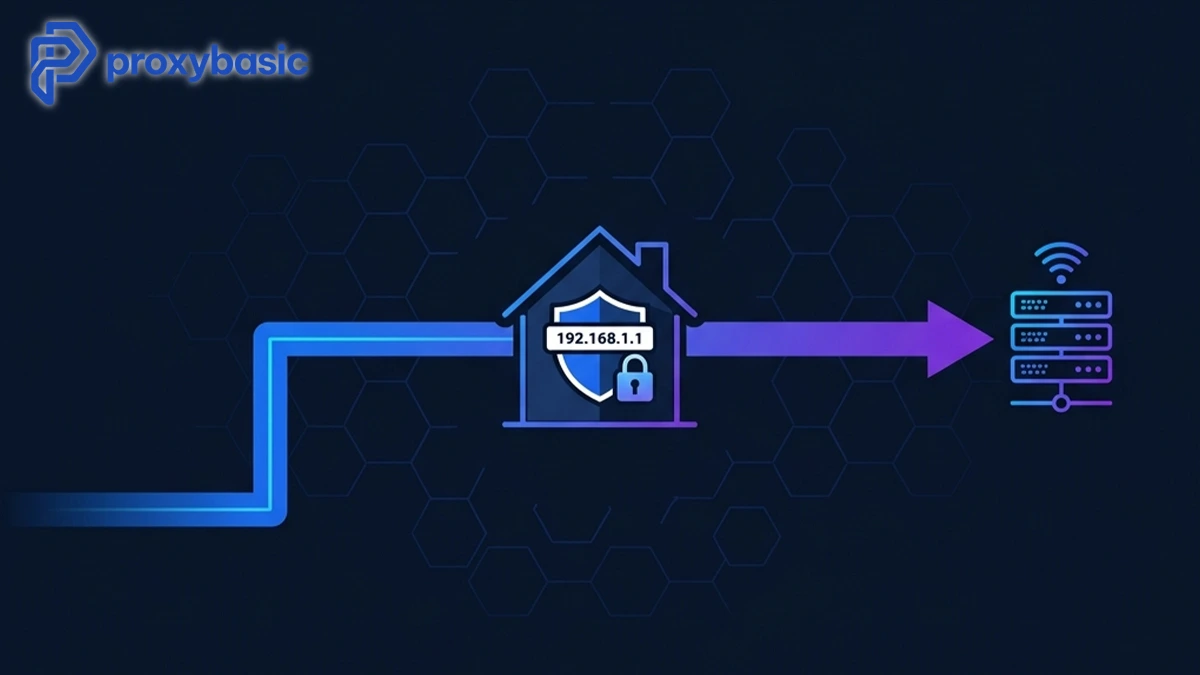
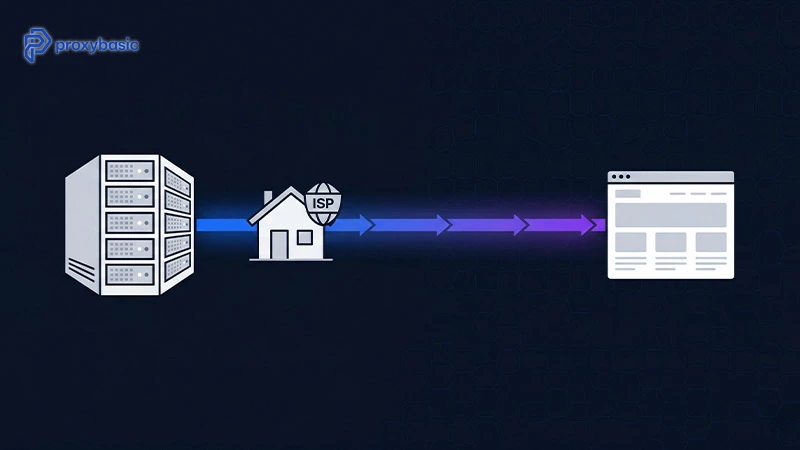
Static residential proxies (often called ISP proxies) use IP addresses assigned by real ISPs and hosted on datacenter infrastructure, giving them datacenter-grade speed with the residential ASN classification that anti-bot systems trust. Picking the right provider means matching the proxy to the task: account management needs a stable, fixed IP with consistent session identity; geo-targeted research needs ZIP-code or ASN-level targeting; high-volume scraping needs unlimited session duration and fast throughput. Below is a full breakdown of each provider and every selection criterion that matters before spending a dollar.
What Are the Best Static Residential Proxy Providers in 2026?
The 6 best static residential proxy providers in 2026 are Decodo, Oxylabs, Bright Data, IPRoyal, NetNut, and Webshare, ranked across speed, ASN quality, IP pool size, location depth, and pricing model.
Here is a full overview of each provider. The table below compares static residential proxy providers across the 5 criteria that matter most for real-world tasks. Reading this table before picking a provider saves time by filtering out options that do not match your budget or targeting requirements.
|
Provider |
Speed |
ASN Quality |
IP Pool |
Location Depth |
Pricing Model |
|
Decodo |
Fast |
Premium |
Mid-size |
Country/City |
Per IP/month |
|
Oxylabs |
Very fast (0.18s) |
Premium consumer |
Large |
Country/City |
Per IP/month |
|
Bright Data |
Fast |
Premium |
Large |
Country/City/ZIP |
Per IP + traffic |
|
IPRoyal |
Moderate |
Standard |
Mid-size |
Country |
Per IP/month |
|
NetNut |
Fast |
ISP-direct |
1M+ IPs |
Country/City/ASN |
Per GB |
|
Webshare |
Fast |
Standard |
Mid-size |
Country |
Per IP/month |
Each provider below covers what it does best, what task it fits, and what the pricing structure looks like.
Decodo – The Best Pick for Teams on a Budget
Decodo (formerly Smartproxy) wins on affordability for dedicated ISP IPs, offering premium ASNs, a flexible subscription model, and a developer-friendly API at a price point well below enterprise-tier competitors.
More specifically, Decodo gives teams access to static residential IPs across 10+ countries with both shared and dedicated options. The premium ASN coverage means IPs pass through consumer-grade internet service providers like AT&T and Comcast, which reduces detection risk on medium-security sites. The dev-friendly API supports direct integration into scraping pipelines, browser automation tools, and account management setups without manual configuration overhead.
- Best for: Account management on social platforms, medium-scale scraping on e-commerce and price aggregation sites, and development teams that need programmatic proxy control.
- Pricing: Per IP per month. Shared plans start lower; dedicated plans carry a premium but deliver cleaner IP reputation and no co-use risk.
- Watch out for: Average response time compared to Oxylabs. No city-level or ASN-level targeting, which limits precision for geo-specific research tasks.
Oxylabs – Leads on Speed and Uptime for Enterprise Use
Oxylabs leads on raw performance, with a 0.18-second average response time, unlimited session duration, and premium consumer ASNs that hold up against aggressive anti-bot systems at scale.
On top of that, Oxylabs operates dedicated proxies only, which means no shared-use risk on IP reputation. The unlimited session duration removes the session timeout problem that breaks long-running scraping jobs on other providers. Premium consumer ASNs from major US carriers keep detection rates near zero on platforms that block datacenter traffic outright.
- Best for: High-volume scraping on protected platforms, enterprise operations that need near-perfect uptime, and any task where session interruption causes data loss or account flags.
- Pricing: Per IP per month, dedicated only. Among the more expensive options in the market, but the performance gap justifies the cost for volume-dependent operations.
- Watch out for: Limited geo-targeting options. Oxylabs covers major countries but does not offer city-level or ASN-level targeting on static residential plans.
Bright Data – Wins on Location Coverage
Bright Data covers 50+ countries with city-level targeting, shared and dedicated IP options, and a management dashboard that enterprise teams use to monitor proxy health, rotate addresses, and track usage in real time.
Beyond that, Bright Data’s location depth is the widest available among static residential proxy providers. City-level targeting makes it the go-to option for geo-targeted market research, localized ad verification, and compliance testing across multiple regions. The management tools reduce operational overhead for teams running proxies at scale: usage dashboards, API controls, and IP replacement workflows are all built into the platform.
- Best for: Geo-targeted research, multi-region ad verification, large enterprise operations that need both location precision and proxy management tooling.
- Pricing: Per IP plus traffic fees. Among the most expensive providers in the market. Fair-usage fees apply on some plans, so usage monitoring is needed to avoid surprise charges.
- Watch out for: Cost adds up fast for high-bandwidth tasks. Traffic fees on top of IP fees make Bright Data far more expensive than per-IP-only providers for data-intensive scraping jobs.
IPRoyal – The Top Budget Option for Static Residential IPs
IPRoyal offers the lowest price point among dedicated static residential proxy providers, with 30+ country coverage, unlimited traffic on most plans, and dedicated IPs that keep reputation risk low for individual users and small teams.
Specifically, IPRoyal’s pricing sits well below the market average for dedicated static residential IPs, making it the practical starting point for users testing static proxies for the first time or running low-frequency tasks that do not justify enterprise-tier spending. Unlimited traffic removes the per-GB cost anxiety that makes residential proxies unpredictable for bandwidth-heavy use.
- Best for: Individual users, small-scale tasks, beginners evaluating static residential proxies before committing to a larger plan, and low-frequency use cases like occasional geo-checks or manual account management.
- Pricing: Per IP per month, dedicated only. One plan covers one location, which limits flexibility for multi-region operations.
- Watch out for: Slower download speed compared to Oxylabs and Decodo. Does not scale well for large operations: the one-location-per-plan structure creates friction for teams needing IPs across multiple countries simultaneously.
NetNut – The Right Choice for ASN-Level Geo-Targeting
NetNut sources proxies directly from ISPs and offers city-level, state-level, and ASN-level targeting across 30+ countries, backed by a pool of over 1 million static residential IPs.
That precision, however, comes at a cost. NetNut uses traffic-based pricing rather than per-IP billing, which means high-bandwidth operations pay more as volume increases. The ASN-level targeting is the key differentiator: users can target specific internet service providers by ASN code, which matters for tasks where the target site behaves differently depending on the user’s carrier. This level of precision is not available on Decodo, IPRoyal, or Webshare.
- Best for: Heavily protected platforms where carrier-level targeting changes access outcomes, precise geo-accuracy tasks that need city or ASN specificity, and operations where IP pool size matters for avoiding blocks.
- Pricing: Per GB of traffic consumed. Expensive relative to per-IP providers for high-bandwidth use cases.
- Watch out for: Traffic-based pricing becomes costly fast for scraping-heavy workflows. NetNut fits best for targeted, lower-volume tasks that require precision over volume.
Webshare – Works Best for Self-Service Proxy Management
Webshare gives users full control over their proxy setup: shared and dedicated IPs, optional rotation on static pools, a high success rate on most target sites, and an affordable base price that stays manageable for individual operators.
Beyond pricing, Webshare’s self-service model suits users who want to manage their proxy list without account manager involvement. Optional rotation on static pools is a feature most providers do not offer: users can run static IPs by default and switch to on-demand rotation when a target site starts flagging session length. The platform’s API makes list management, IP testing, and usage tracking accessible without enterprise-level tooling.
- Best for: Flexible use cases where session behavior needs to change by task, individual users who want control over proxy configuration, and teams that need affordable shared IPs for lower-security targets.
- Pricing: Per IP per month. Base price is low but upsells for premium features (higher-tier ASNs, rotation controls, extended location coverage) add up fast.
- Watch out for: Mostly US IPs on base plans. Country-level targeting only, no city or ASN precision. Upsell structure means the real cost is higher than the advertised entry price.
What Criteria Should You Use to Choose a Static Residential Proxy Provider?
Choosing a static residential proxy provider comes down to 5 criteria: IP pool size and location depth, pricing model fit, IP type (dedicated vs shared vs semi-dedicated), ASN coverage, and proxy management tooling. Each criterion below is broken down with enough detail to make a clear decision before committing to a plan.
IP Pool Size and Location Coverage at Country, City, and ASN Level
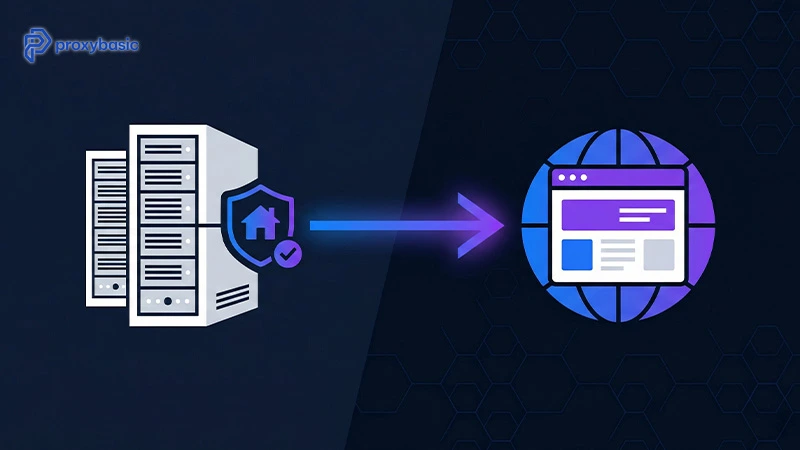
Pool size and location depth are the two criteria that most directly affect whether a static residential proxy works for your specific task. A small pool increases the chance of reusing a flagged IP. Shallow location coverage blocks geo-specific research entirely.
Pool size matters for these reasons:
- Small pools (under 100,000 IPs) increase the probability that the IP you receive has been used aggressively by a previous buyer, which carries higher block risk on sensitive targets.
- Larger pools (500,000 to 1M+) give providers more clean addresses to assign, which keeps average IP reputation higher across the board.
- Dedicated IPs remove the shared-use variable entirely: the IP belongs to one buyer, so reputation depends only on how that buyer uses it.
Location depth breaks down into 3 levels:
|
Targeting Level |
What It Covers |
When You Need It |
|
Country |
Routes through a country’s ISP network |
General geo-bypass, basic market research |
|
City |
Narrows to a specific metro area |
Local pricing data, regional ad verification |
|
ASN |
Targets a specific internet service provider |
Carrier-specific access, high-security platform bypass |
To be specific, ASN-level targeting is the only option for tasks where a target site returns different content or applies different rate limits depending on the user’s ISP. NetNut is currently the only provider among the six reviewed that supports ASN-level selection on static residential plans.
Pricing Models Per IP vs Per GB: Which One Saves You More?
Per-IP-per-month pricing saves more for high-bandwidth, continuous tasks. Per-GB pricing saves more for low-frequency, precision tasks. The right model depends on how much data you move per month and how predictable your usage pattern is.
The table below compares static residential proxy pricing models across bandwidth level and use case type. Reading this before selecting a provider prevents overpaying by 2x to 5x for the wrong billing structure.
|
Pricing Model |
Cost Structure |
Best For |
Watch Out For |
|
Per IP/month |
Fixed monthly fee per IP, unlimited or high bandwidth |
Scraping, price monitoring, account management at volume |
IP count caps; need enough IPs to avoid reuse |
|
Per GB |
Pay for data transferred, regardless of IP count |
Ad verification, geo-checks, low-frequency research |
Costs spike fast for scraping-heavy workflows |
As a concrete example, a team running price monitoring on 50 e-commerce sites 24 hours a day will move terabytes of data per month. Per-GB pricing at $3 to $15 per GB on that volume becomes prohibitively expensive. Per-IP pricing at $2 to $5 per IP per month with unlimited bandwidth cuts that cost to a fixed, predictable number. By contrast, a team running 20 ad verification checks per week moves minimal data. Paying a fixed per-IP monthly fee for that volume wastes budget on idle IPs.
Dedicated vs Shared vs Semi-Dedicated: Which Type Fits Your Task?
Static residential proxies come in 3 types based on how many users share each IP: dedicated (1 user), shared (multiple users), and semi-dedicated (small group of users). Each type has a different cost, IP reputation profile, and use case fit.
Dedicated static residential proxies
- Assigned to one buyer only. No other user’s behavior affects the IP’s reputation.
- Highest IP reputation among the three types, since the address is clean from shared-use risk.
- Best for: scraping advanced anti-bot systems, account management on sensitive platforms, and any task where IP reputation directly affects success rate.
- Pricing: highest cost per IP, typically $2 to $10 per IP per month depending on location and ASN quality.
Shared static residential proxies
- Multiple buyers use the same IP simultaneously or in rotation.
- Lower cost, but IP reputation depends on how other buyers on the same address behave.
- Best for: managing multiple accounts on medium-security platforms, scraping lightly protected sites, and tasks where occasional detection is acceptable.
- Pricing: lowest cost per IP, sometimes available for under $1 per IP per month.
Semi-dedicated static residential proxies
- Shared with a small, defined group of buyers (typically 3 to 5 users per IP).
- Middle ground: lower risk than fully shared IPs, lower cost than dedicated.
- Best for: tasks that need better IP cleanliness than shared but cannot justify dedicated pricing.
- Pricing: between shared and dedicated, varies by provider.
IP replacement policy is a separate factor that applies to all three types. When a static IP gets flagged or blocked, the provider’s replacement policy determines how fast a clean address becomes available. Providers like Decodo and Oxylabs include replacement in the plan; others charge per replacement or require a support request. Check this before buying, especially for sensitive account management tasks where downtime carries direct cost.
What Is the Difference Between Static and Rotating Residential Proxies?
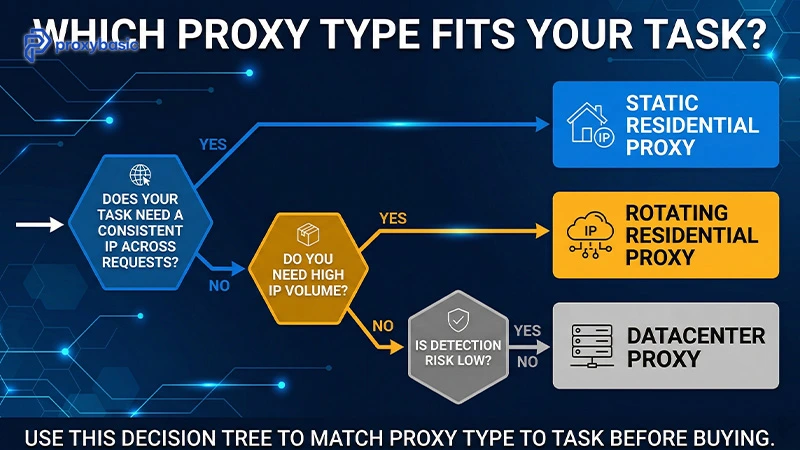
Static residential proxies hold the same IP across all requests in a session. Rotating residential proxies assign a new IP from a pool on every request or at set time intervals. This single difference creates cascading effects on anonymity, session stability, cost, and use case fit.
The line between the two is not always fixed, though. Some providers (Decodo and Webshare among them) offer optional rotation on static residential pools: the IP stays fixed by default, but the user can trigger a rotation on demand or set a rotation interval. This hybrid behavior covers scenarios where session persistence is needed most of the time but IP variety becomes necessary at specific steps.
Can Static Residential Proxies Rotate? How Does Optional Rotation Work?
Yes, static residential proxies can rotate on providers that support optional rotation. Decodo, Webshare, and NetNut all offer this feature. The default behavior keeps the IP fixed; the user activates rotation either on demand through the API or by setting a time-based interval in the proxy dashboard.
Two rotation modes available on supporting providers:
- Sticky session mode: The proxy holds the same IP for a defined period (typically 1 to 30 minutes). After the session window closes, the proxy assigns a new IP from the static pool. This mode suits scraping tasks that need session continuity within a window but benefit from IP variety across multiple windows.
- On-demand rotation: The user triggers an IP change via API call whenever the task requires it. This mode suits account management workflows where a specific job needs a new IP without waiting for a timed window to expire.
To be clear, optional rotation on static pools is different from rotating residential proxies. Static pool rotation still draws from a limited set of ISP-registered IPs hosted on datacenter infrastructure. Rotating residential proxies pull from millions of real end-user devices. The IP variety available through optional static rotation is far smaller, but the IP quality (speed, reputation, session stability) stays higher.
When Should You Use Rotating Proxies Instead of Static Residential Proxies?
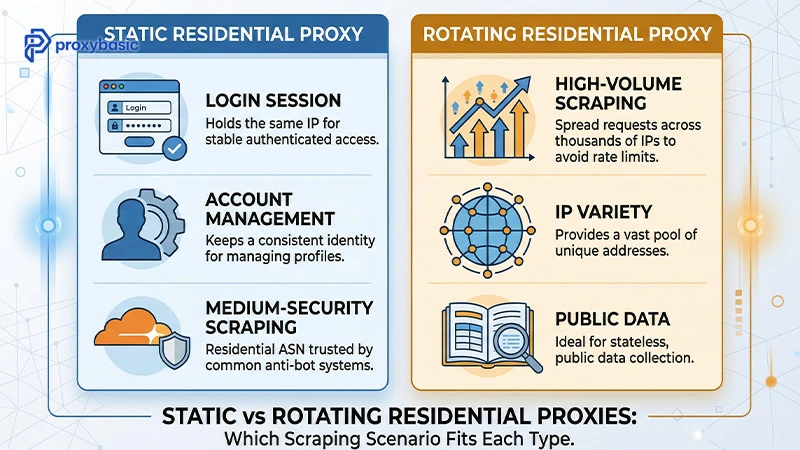
Use rotating residential proxies instead of static residential proxies in 3 scenarios: the task requires more IP addresses than any static pool can provide, the target site fingerprints session length and blocks long-running sessions, or the operation needs geographic spread across thousands of locations simultaneously.
Signal 1: The target starts rate-limiting your static IP. A static IP hitting the same endpoint repeatedly triggers rate limits faster than a rotating pool spreading the same request volume across thousands of IPs. When block rates start climbing despite residential ASN status, rotation is the correct move.
Signal 2: The scraping job needs public data only, no session persistence. If requests are stateless (each request stands alone, no login, no cart, no session cookie), rotating residential proxies deliver more requests per dollar because the pool is larger and per-IP cost averages lower.
Signal 3: The operation needs volume over precision. A job collecting millions of data points from a lightly protected site benefits from IP volume more than from session stability. Static residential proxies hit scale limits faster than rotating residential pools on volume-dependent tasks.
FAQ
Are Static Residential Proxies Good for Web Scraping?
Yes, static residential proxies work well for web scraping, with 3 specific conditions: the target site requires session persistence, the scraping job runs login-based requests, or the target applies carrier-level filtering that blocks datacenter IPs.
Are Static Residential Proxies Worth the Cost?
Yes, static residential proxies are worth the cost for 3 specific scenarios: account management that requires a consistent IP identity, scraping on platforms that block datacenter traffic, and geo-targeted research that needs city or ASN-level location precision. For tasks outside these scenarios, datacenter proxies or rotating residential proxies deliver better cost efficiency.
Are There Legal Considerations When Using Static Residential Proxies for Scraping?
Yes, there are legal considerations when using static residential proxies for scraping, and they fall into 3 categories: Terms of Service compliance with the target site, robots.txt adherence, and data protection regulations (GDPR, CCPA) that govern how scraped data is stored and used.
Conclusion
Static Residential Proxies remain one of the best proxy solutions for tasks that require stable sessions, residential ASN trust, and datacenter-level speed. Whether you need reliable account management, long-session web scraping, geo-targeted research, or carrier-level targeting, choosing the right provider directly impacts performance, detection rates, and operational cost.
The best Static Residential Proxies in 2026 are not defined by price alone. Pool quality, ASN coverage, location depth, session flexibility, and pricing structure all determine which provider fits your workflow best. Match the proxy type to the task, and static residential proxies will consistently deliver the speed, stability, and legitimacy that modern anti-bot systems demand.