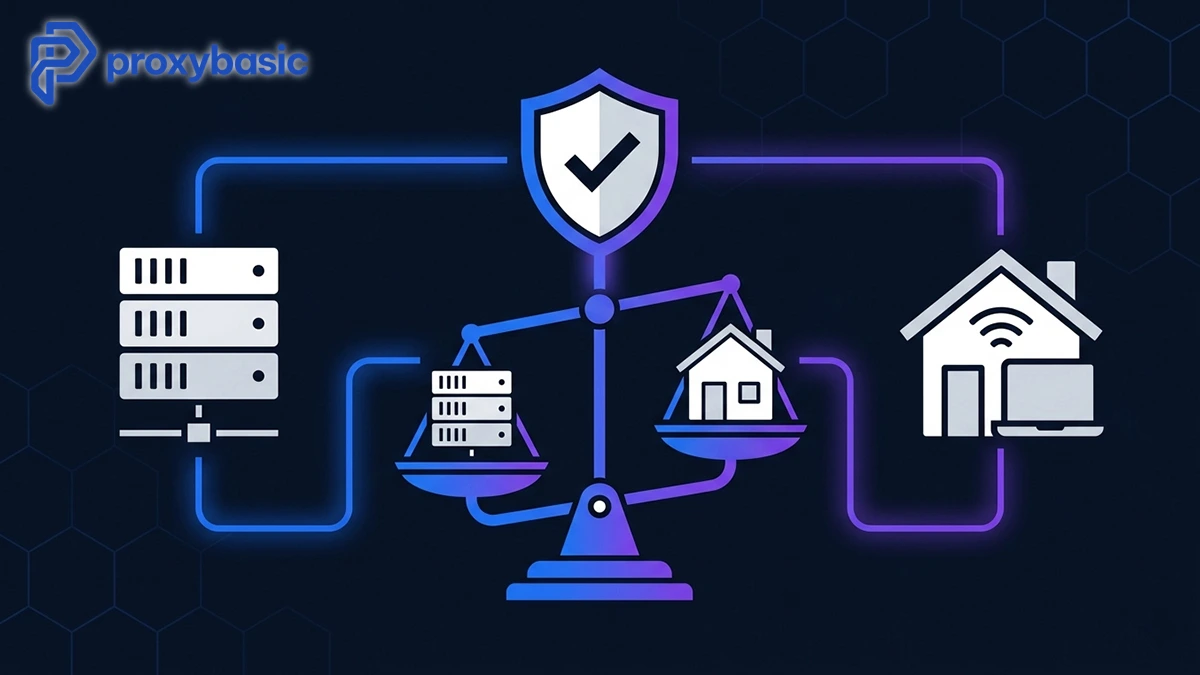
ISP vs residential proxy differ on four core dimensions: IP source, speed, anonymity, and session behavior. ISP proxies win on datacenter-grade speed and static session stability, while residential proxies win on real-device anonymity, IP pool diversity, and geo-targeting precision.
ISP proxies use IP addresses leased from ISPs but hosted on datacenter servers, giving them the hybrid advantage of residential ASN classification with datacenter performance. Residential proxies route every request through real home devices, making them the hardest proxy type for anti-bot systems to detect. The gap between these two proxy types is not about which is more advanced. It is about which one matches your operational requirement.
For anyone choosing between ISP proxies vs residential proxies in 2026, this guide covers every dimension that matters: IP source, speed, anonymity, session type, pool size, cost model, and real-world use cases. Understanding these differences is what prevents costly mismatches between the proxy you buy and the task you need to complete.
What Is an ISP Proxy?
An ISP proxy is an intermediary server that uses IP addresses leased directly from Internet Service Providers but hosted on datacenter infrastructure, delivering a hybrid advantage of residential ASN classification with datacenter-grade connection performance.
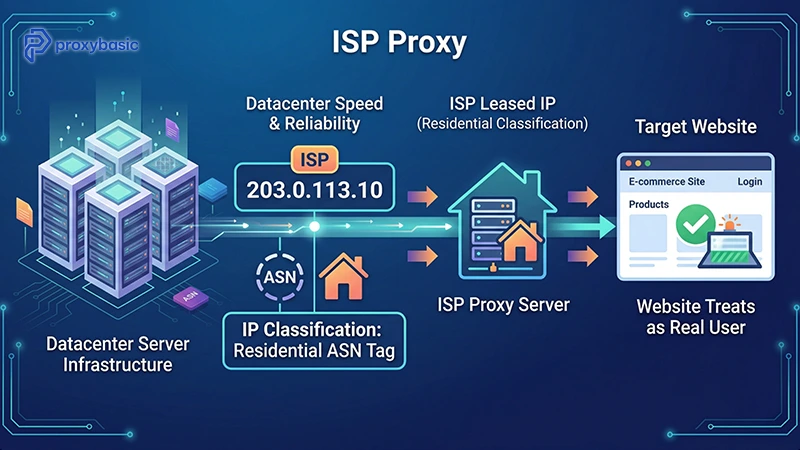
This hybrid structure is the defining feature of the ISP proxy category. When a provider leases a block of IPs from an ISP and hosts them on dedicated servers, the resulting ISP proxy carries a residential-looking ASN, so target websites classify the traffic as a real user, while the actual connection runs on high-performance hardware capable of 10 Gbps or more. This is distinct from a pure datacenter proxy, where both the IP and infrastructure origin are traceable to a commercial server pool.
ISP proxies are static by default: the same IP persists across requests unless you manually rotate it. This makes them the right fit for tasks that require a consistent, long-lived digital identity. Account management, SEO tools, and ad verification are the clearest use cases. The term “static residential proxy” is often used interchangeably by different providers, but the correct label is ISP proxy whenever the IP is hosted on datacenter infrastructure, regardless of where the IP was registered.
What Is a Residential Proxy?
A residential proxy is an intermediary server that routes traffic through real IP addresses assigned by ISPs to actual household devices, making requests appear to originate from genuine home users and indistinguishable from organic traffic at the network level.
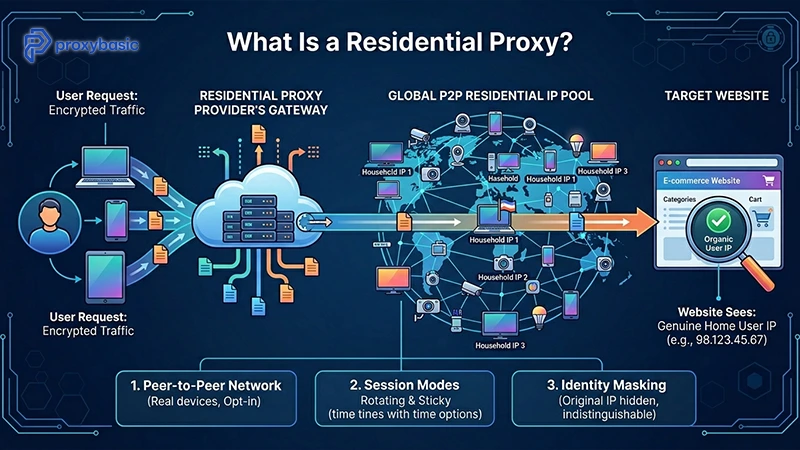
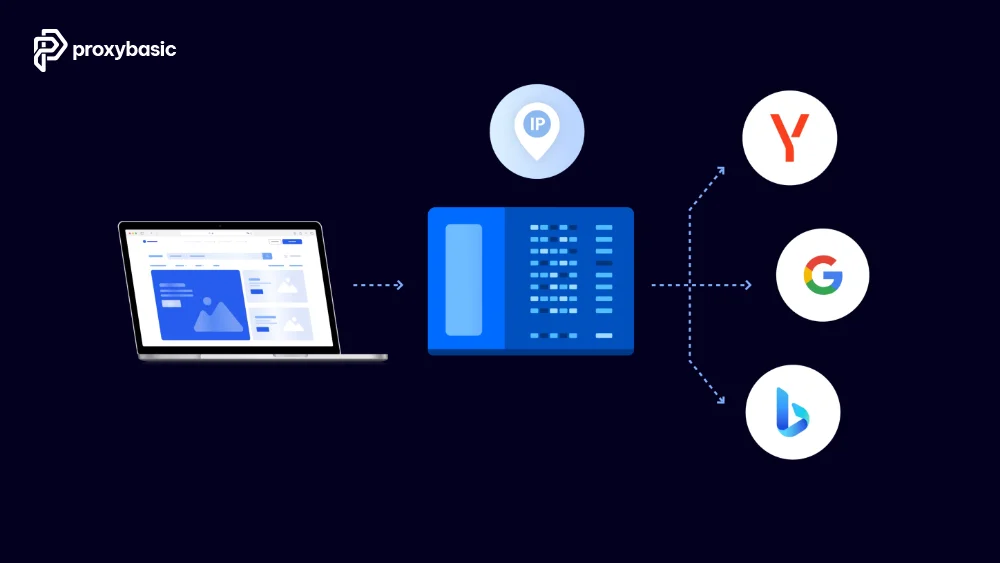
Residential proxies operate through peer-to-peer networks where real device owners opt in to share their internet connection in exchange for compensation or app benefits. The provider’s gateway selects an available IP from this pool and routes your request through it, so the target website sees only the residential device’s IP, never your own. This is what makes residential proxies the hardest proxy type for anti-bot systems to detect: the traffic originates from real devices with genuine ISP-assigned IPs and real-world behavioral signals.
Residential proxies offer two session modes that give users direct control over identity persistence:
- Rotating residential proxy mode: a new IP is assigned per request or at set intervals, suited for large-volume scraping where IP diversity prevents blocking
- Sticky mode: the same IP is held for 1 to 30 minutes, useful for tasks requiring short-term session continuity such as checkout flows or form submissions
ISP vs Residential Proxy: Key Differences
ISP proxies vs residential proxies split across 7 measurable criteria: IP source, speed, anonymity, session type, geo-targeting depth, pool size, and pricing. Each difference maps directly to a different category of operational task.
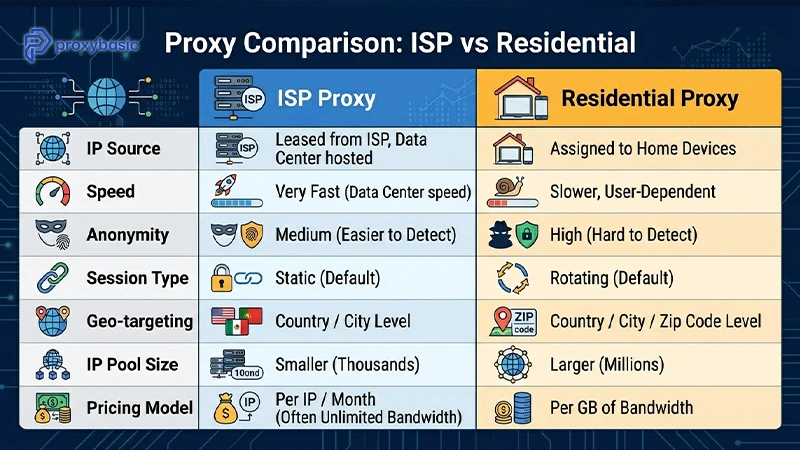
The table below compares ISP proxies vs residential proxies across every criterion that matters for real-world use. Reading this table before selecting a proxy type eliminates the most common and costly mismatches between tool and task.
| Criteria | ISP Proxy | Residential Proxy |
| IP source | ISP-leased, datacenter-hosted | ISP-assigned to real home device |
| Speed | Very fast (10 Gbps+ datacenter) | Moderate (depends on real device) |
| Anonymity | Medium (residential ASN, datacenter pattern) | High (real device behavior, hardest to detect) |
| Session type | Static by default | Rotating by default |
| Geo-targeting | Country / city | Country / city / ZIP code |
| Pool size | Thousands | Millions |
| Pricing model | Per IP/month (unlimited bandwidth) | Per GB of traffic consumed |
When comparing ISP proxies vs residential proxies directly: ISP proxies are the faster, more cost-predictable option with stable sessions; residential proxies offer superior anonymity, broader IP diversity, and precise geo-targeting at the cost of variable speed and per-GB billing. Neither type is universally superior. The right choice is determined entirely by what your task demands.
ISP vs Residential Proxy: Use Cases
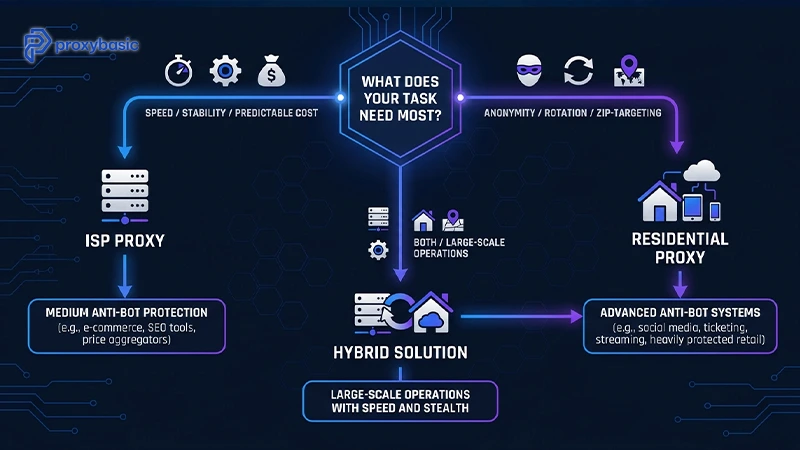
ISP proxies vs residential proxies serve different operational needs: ISP proxies are the right tool when speed, static sessions, and cost predictability define success; residential proxies are the required tool when anonymity, IP rotation at scale, and anti-bot bypass define success.
When to Use ISP Proxies
ISP proxies deliver the best results when your task requires high throughput, static IP behavior, and medium-level anti-bot bypass:
- Account management and social media automation – A static IP maintains consistent identity across sessions, directly reducing the risk of account flags triggered by IP changes.
- High-speed web scraping on medium-security sites – Datacenter-grade performance handles large request volumes without the per-GB cost penalty of residential proxies.
- SEO rank tracking and price monitoring – Frequent, repeated requests to the same targets benefit from stable, fast connections that ISP proxies reliably provide.
- Ad verification – ISP proxy IPs appear legitimate to ad platforms while delivering fast load times for creative verification workflows.
When to Use Residential Proxies
Residential proxies are the necessary choice when target sites deploy advanced anti-bot systems or require precise geo-accuracy that ISP proxies cannot deliver:
- Scraping heavily-protected platforms (Cloudflare, Akamai, DataDome) – Real device IP behavior passes detection layers that consistently flag ISP proxy traffic patterns.
- Social media scraping – Platforms like Instagram, LinkedIn, and X aggressively block datacenter-origin traffic; residential proxies are the minimum requirement.
- Geo-targeted market research – ZIP code-level targeting provides data accuracy that no ISP proxy pool can replicate by design.
- Bypassing IP bans at scale – Rotating pools of millions of real IPs make persistent blocking effectively impossible, a capability unique to residential proxies.
ISP vs Residential Proxy: Which Should You Choose?
Choosing between ISP proxies vs residential proxies comes down to four factors: speed vs. anonymity priority, session type requirement, pricing model preference, and the sophistication of your target site’s anti-bot system, not which proxy type costs more.
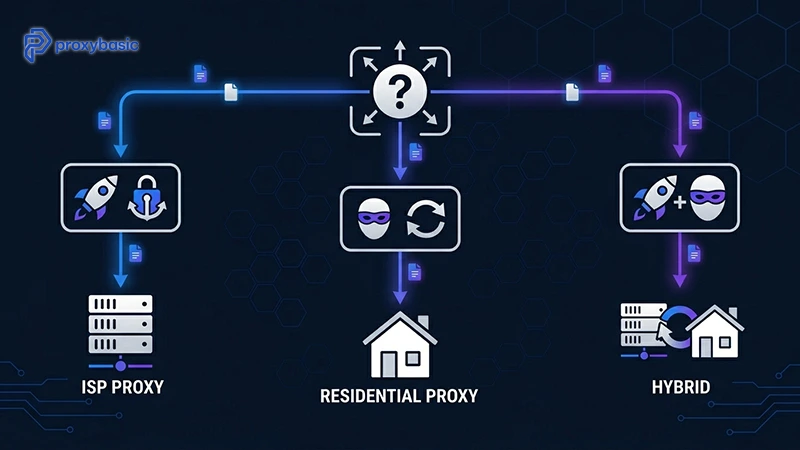
Use this decision framework to identify your fit:
- Choose ISP proxies if: Your task requires high speed, unlimited bandwidth, static sessions, and predictable monthly cost. Target sites use medium-level anti-bot protection, such as most e-commerce platforms, SEO rank trackers, price aggregators, and standard retail.
- Choose residential proxies if: Your task requires maximum anonymity, IP rotation at scale, and ZIP-level geo-targeting. Target sites use advanced anti-bot systems, including social media platforms, ticketing services, streaming platforms, and enterprise-grade protected retail.
- Choose both if: You run large-scale operations where speed-dependent tasks (account management, rank tracking) and stealth-dependent tasks (social scraping, geo-research) run in parallel. This hybrid approach is what advanced proxy users increasingly adopt in 2026.
When comparing ISP proxies vs residential proxies at the decision level: ISP proxies are the right tool when speed and session stability define success; residential proxies are the right tool when anonymity, IP diversity, and anti-bot bypass define success. Match the proxy type to the task, and both will consistently deliver.
Conclusion
ISP proxies vs residential proxies represent two fundamentally different tools built for two different categories of work. ISP proxies give you datacenter speed, static sessions, and predictable monthly billing. Residential proxies give you real-device anonymity, massive rotating IP pools, and ZIP-level geo-accuracy, at the cost of per-GB pricing and variable speed.
The decision is not about which type is more advanced. It is about which one matches your operational requirement. Use the comparison table, use case breakdowns, and decision framework in this guide to identify the right fit and commit with confidence. If you need both, a hybrid proxy setup covers every workload from one account.
Ready to get started? Visit ProxyBasic for residential and ISP proxy plans, with transparent pricing, real-IP pools, and technical support to match the right proxy to your task from day one.