An SEO proxy is a residential or ISP-assigned IP address used to simulate real user searches from a specific location, so rank tracking tools return results that match what an actual local user sees. Without one, local rank data collected from a remote server reflects the wrong location, and repeated checks from the same IP trigger rate limits or search engine filtering that distorts your reports.
The difference between proxy types determines how reliable your local SEO proxy tracking data is. Residential proxies use IPs tied to real home connections, making them nearly indistinguishable from organic user traffic. Datacenter proxies are faster and cheaper, but search engines flag them at a block rate of around 43%, compared to roughly 2% for residential IPs. For city-level rank tracking, that gap directly affects data accuracy.
What Is an SEO Proxy and How Does It Work?
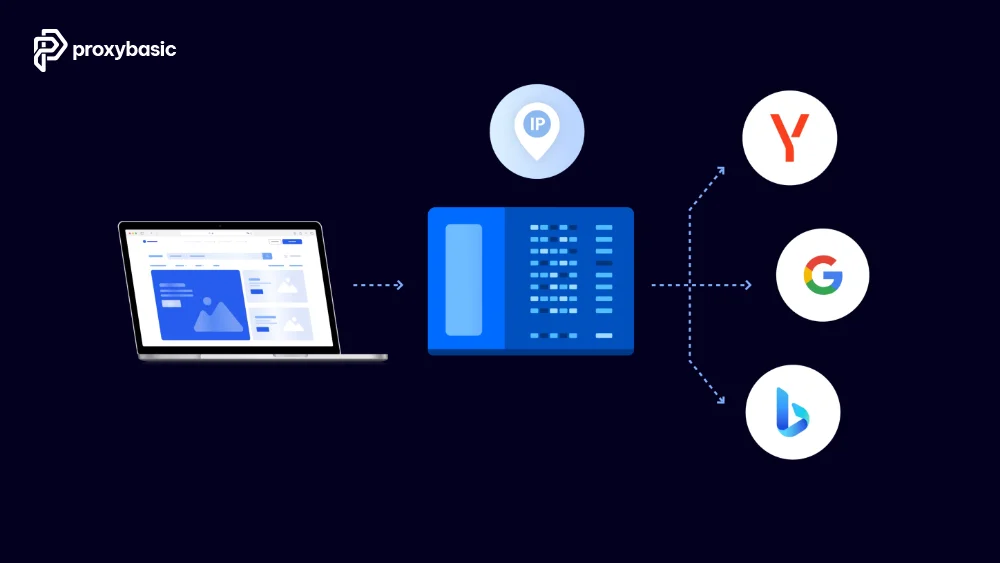
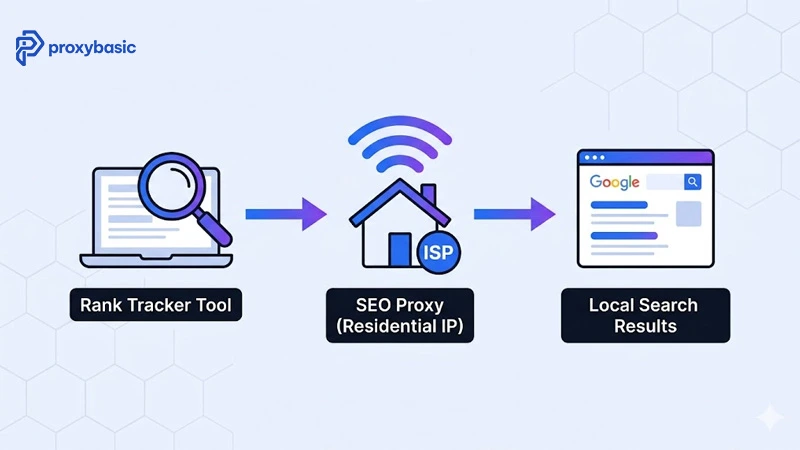
An SEO proxy is an intermediary server that routes your rank tracking requests through a real ISP-assigned IP address in a specific city, so the search engine returns results exactly as it would for a genuine local user. The rank tracker sends a query, the proxy forwards it from a residential IP in the target location, and the result reflects what someone in that city actually sees.
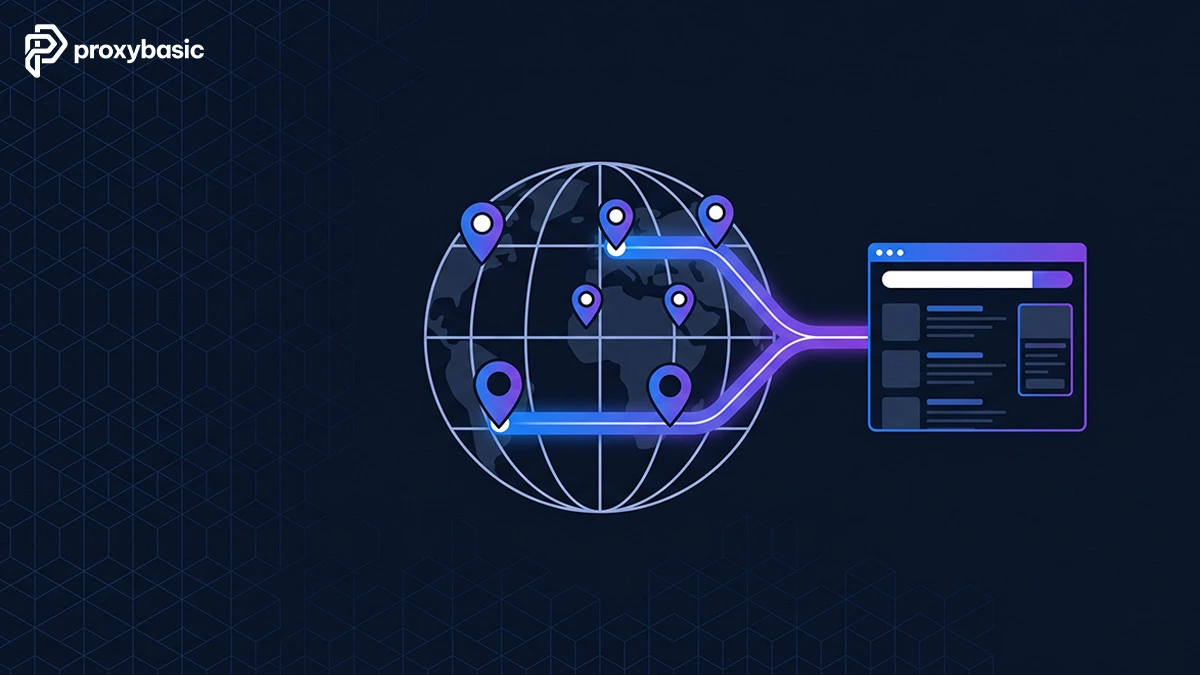
This matters because Google personalizes results based on the IP making the request. A tracking server in New York checking rankings for “plumber near me” in Chicago will get New York results unless the request routes through a Chicago residential IP. The same logic applies to Map Pack rankings, where positions can vary by neighborhood.
Why Datacenter Proxies Fail for Local SEO Tracking
Datacenter proxies fail for local SEO proxy tracking because search engines identify and filter them in milliseconds. These IPs originate from cloud hosting providers like AWS and DigitalOcean, which are catalogued by Google’s bot detection systems. The practical result is a block rate around 43% for datacenter IPs versus roughly 2% for residential proxies, and local result accuracy that drops significantly with datacenter sources.
For any SEO proxy setup where data accuracy drives decisions, the cost difference between datacenter and residential proxies is smaller than the cost of acting on wrong ranking data.
Residential vs Datacenter Proxies: Key Metrics
The table below covers the core performance differences between residential and datacenter proxies for SEO proxy and local rank tracking use cases. Reviewing these numbers helps you understand why provider selection matters before comparing pricing.
| Metric | Datacenter Proxy | Residential Proxy |
|---|---|---|
| Block rate | ~43% | ~2% |
| Local result accuracy | ~67% | ~94% |
| Detection risk | High | Low |
| Cost per GB | $ | $$ |
| Best use case | Bulk scraping, low-friction sites | Local rank tracking, SERP monitoring |
Top 9 SEO Proxy Providers for Local Rank Tracking
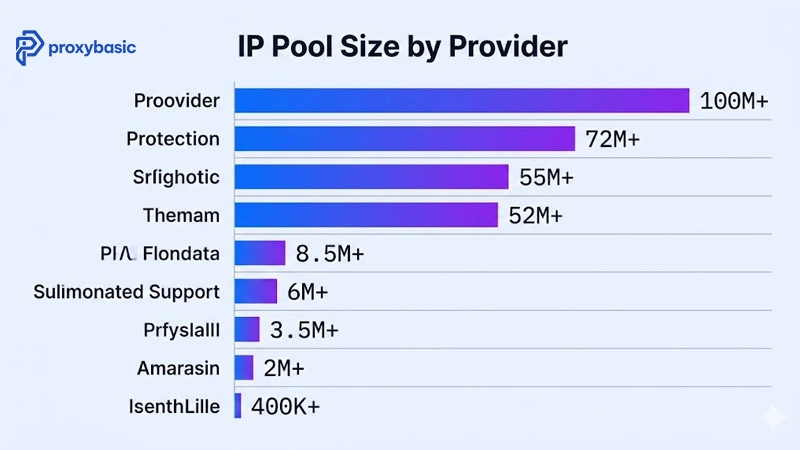
There are 9 residential SEO proxy providers suited for local rank tracking in 2026, ranked by IP pool size, targeting precision, pricing, and accuracy. The table below summarizes all options before the full breakdown.
| Provider | IP Pool | Pricing | Avg. Success Rate | Targeting | Best For |
|---|---|---|---|---|---|
| Bright Data | 72M+ | ~$10.5/GB | 97–99% | ZIP / ASN | Enterprise |
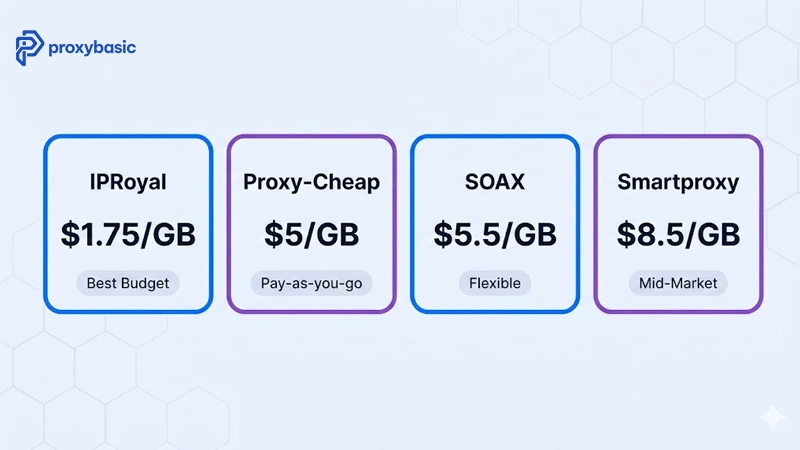
| Smartproxy | 55M+ | ~$8.5–10/GB | 95–98% | City | Mid-size agencies |
| Oxylabs | 100M+ | ~$12/GB | 97–99% | City / API | High-volume SERP |
| SOAX | 8.5M+ | ~$5.5–7.4/GB | 94–97% | City / ISP | Flexible rotation |
| IPRoyal | 2M+ | ~$1.75+/GB | 90–95% | City (limited) | Budget entry |
| NetNut | 52M+ | ~$300/mo (20GB) | 97–99% | City | Speed-focused |
| GeoSurf | 3.5M+ | ~$10/GB | 96–98% | ZIP / GPS | Hyperlocal |
| Proxy-Cheap | 6M+ | ~$5/GB | 92–96% | Country / City | Pay-as-you-go |
| Storm Proxies | 400K+ | ~$50/mo | 85–92% | Limited US/EU | Beginners |
1. Bright Data: Best for Enterprise Local SEO Tracking
Bright Data is the strongest SEO proxy option for enterprise-scale local rank tracking, with a 72M+ IP pool, ZIP and ASN-level targeting, and a 97–99% average success rate across residential networks.
Its key advantage over other providers is targeting granularity. While most services offer city-level targeting, Bright Data supports ZIP code and ASN selection, which matters when ranking positions vary within a single city. The platform also offers intelligent IP rotation and session control for high-volume multi-city campaigns.
Best fit:
- Agencies managing 50+ client locations
- Enterprise SEO teams tracking thousands of keywords daily
- Projects where data accuracy directly affects revenue decisions
The trade-off is cost. At approximately $10.5/GB, it sits at the premium end of the market. For teams where bad data is more expensive than the tool, the investment holds up.
2. Smartproxy: Best Balance of Cost and Precision
Smartproxy delivers city-level targeting with a 55M+ IP pool at $8.5–10/GB, giving mid-size agencies a reliable SEO proxy setup without enterprise-level complexity or pricing.
In practical local SEO proxy tracking workflows, Smartproxy is often the most efficient option. It skips the advanced configuration layers (ASN targeting, ISP selection) that enterprise tools require, which reduces onboarding time significantly.
Best fit:
- Agencies tracking 10–30 cities
- Mid-size SEO teams scaling from manual to automated tracking
- Budget-aware operations that still need consistent accuracy
3. Oxylabs: Best for High-Volume SERP Monitoring
Oxylabs leads on raw IP pool size at 100M+ and includes a built-in SERP API that handles proxy management, session control, and result parsing in one pipeline. For SEO proxy workflows that track thousands of keywords daily, this removes a full layer of engineering overhead.
Rather than acting purely as a proxy provider, Oxylabs functions as a data infrastructure layer for large-scale local SEO proxy tracking operations.
Best fit:
- SEO teams tracking 5,000+ keywords across multiple markets
- Data-driven agencies building custom ranking dashboards
- BI integrations requiring clean structured SERP output
4. SOAX: Best for Flexible IP Rotation
SOAX gives you precise control over how IPs rotate – per request, per session interval, or on a fixed timer – which is useful when tracking platforms have specific request patterns that trigger filtering during local SEO proxy tracking.
With 8.5M+ IPs at $5.5–7.4/GB, it sits in a practical mid-range for teams that need session flexibility without paying enterprise rates.
Best fit:
- Teams testing different rotation strategies
- Projects requiring session stability for multi-step SERP scraping
- Users moving beyond basic rank tracking into custom monitoring setups
5. IPRoyal: Best Budget Entry for SEO Proxies
IPRoyal offers the lowest per-GB entry point at $1.75/GB across a 2M+ IP pool, making it the most accessible SEO proxy option for small-scale local rank tracking without upfront volume commitments.
Coverage depth in smaller cities is limited, and success rates at 90–95% are lower than premium providers. For tracking major cities and primary markets, those trade-offs are acceptable at this price point.
Best fit:
- Freelancers and independent SEO consultants
- Small agencies with single-location clients
- Early-stage testing before committing to a higher-cost provider
6. NetNut: Best for Speed-Sensitive Tracking
NetNut uses ISP proxies – IPs assigned by ISPs but hosted on datacenter infrastructure – which combines residential-level legitimacy with response times of 0.3–0.8 seconds, far faster than standard residential proxies at 2–5 seconds.
At $300/month for 20GB, it is a premium option, but the performance difference is measurable for time-sensitive local SEO proxy tracking workflows where freshness of data matters.
Best fit:
- Large keyword sets requiring frequent daily updates
- Tracking campaigns with tight reporting cycles
- Teams where proxy latency is a bottleneck in the data pipeline
7. GeoSurf: Best for Hyperlocal Targeting
GeoSurf supports targeting down to ZIP code and GPS coordinates, which is the right SEO proxy choice when ranking positions vary within short geographic distances, as is common for service-area businesses.
With 3.5M+ IPs at ~$10/GB and a 96–98% success rate, it delivers reliable precision for campaigns where city-level targeting is not granular enough.
Best fit:
- “Near me” keyword optimization campaigns
- Franchise and multi-location businesses tracking neighborhood-level rankings
- Local service businesses where Map Pack positions shift by a few kilometers
8. Proxy-Cheap: Best Pay-As-You-Go Flexibility
Proxy-Cheap charges on a pay-as-you-go basis at ~$5/GB, which avoids the wasted capacity problem that comes with monthly subscription plans during irregular tracking periods.
With 6M+ IPs and 92–96% success rates, it covers standard local SEO proxy tracking needs without locking you into a fixed monthly spend.
Best fit:
- Seasonal SEO campaigns with variable tracking needs
- Consultants managing multiple small clients with inconsistent tracking schedules
- Agencies onboarding new clients gradually
9. Storm Proxies: Best for Beginners
Storm Proxies simplifies pricing with flat-rate unlimited plans around $50/month, removing per-GB calculation for users new to SEO proxy setups. The trade-off is coverage depth, with approximately 400K IPs concentrated in US and EU markets.
Best fit:
- Developers learning proxy-based rank tracking for the first time
- Small projects tracking primary markets in the US or Europe
- Budget-limited users who prefer predictable monthly costs over per-GB pricing
How to Choose the Right SEO Proxy for Your Use Case
Choosing the right SEO proxy requires matching three factors to your actual tracking needs: geographic coverage, keyword volume, and cost structure.
Geographic coverage is the first decision point. If your campaigns cover major cities only, most providers in this list will deliver. For smaller cities, international markets, or ZIP-level precision, the provider pool narrows quickly. Bright Data and GeoSurf cover the hyperlocal end; Smartproxy and Oxylabs cover city-level at scale.
Keyword volume determines both cost and provider fit. A rough estimate for planning: 1 keyword check uses 0.1–0.5 MB of proxy bandwidth. Multiply by keyword count, city count, and check frequency to estimate monthly GB usage. High-volume operations (10,000+ checks per day) get better ROI with Oxylabs or Bright Data. Lower or variable volume fits pay-as-you-go models.
Cost structure varies more than most buyers expect. Per-GB pricing is flexible but requires usage planning. Subscriptions work for consistent volume. Flat-rate unlimited plans like Storm Proxies trade efficiency for simplicity.
How to Configure City-Level Targeting for Local SEO Proxy Tracking
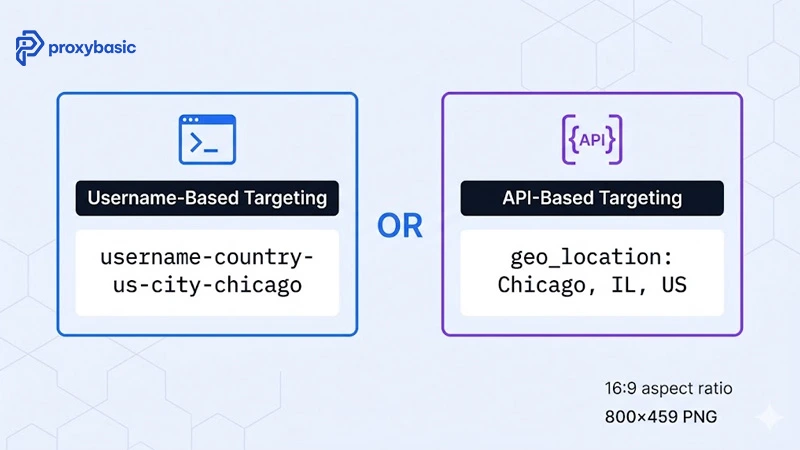
Configuring city-level targeting correctly is where most local SEO proxy tracking setups succeed or fail. Even with a high-quality SEO proxy provider, wrong location parameters return misleading data. Most providers support two configuration methods:
Username-based targeting (common in rotating proxy pools):
username-country-us-city-chicago-session-10
This routes the request through a US residential IP in Chicago and holds the session for a short window.
API-based targeting (common in SERP APIs):
{
  "source": "google_search",
  "query": "plumber near me",
  "geo_location": "Chicago, Illinois, United States"
}
After configuration, always validate by running a location-sensitive query like “weather” and confirming the results match the target city before running production tracking. For multi-city campaigns, create separate proxy configurations per city to prevent data overlap between regions.
Common Issues in SEO Proxy Tracking and How to Fix Them
The table below covers the most common problems that affect local SEO proxy tracking accuracy and stability. Most issues trace back to configuration errors rather than the proxy provider itself.
| Issue | What Happens | Why It Happens | Fix |
|---|---|---|---|
| IP rotation too fast | Requests blocked or flagged | IPs change mid-session | Use sticky sessions for sequential page loads |
| Wrong proxy type | Inconsistent SERP data | Desktop proxies used for mobile queries | Use mobile proxies for “near me” and Map Pack |
| Bandwidth underestimate | Tracking stops early | Usage calculation misses overhead | Add 20–30% buffer to estimated GB |
| Weak geo targeting | Results don’t match target city | Overly broad location settings | Validate city and ZIP parameters with test queries |
| Low coverage in small cities | Higher block rates | Not enough IPs in target region | Choose providers with strong coverage in specific markets |
Conclusion
The 9 SEO proxy providers reviewed here cover every scale and budget for local SEO proxy tracking: Bright Data and Oxylabs for enterprise-grade operations, Smartproxy and NetNut for mid-market teams that need reliability without enterprise complexity, and IPRoyal and Storm Proxies for budget-conscious or small-scale use cases. Matching the right provider to your geographic coverage needs, keyword volume, and cost structure determines whether your local rank data is accurate enough to act on.
For deeper guides on SEO proxy configuration, rotating residential IP setups, and local rank tracking best practices across platforms, visit ProxyBasic to find the right proxy infrastructure for your local SEO workflow.