Residential proxies for SERP monitoring solve the core problem SEO teams face: getting accurate, location-specific ranking data without triggering Google’s anti-bot filters. When requests come from real residential IPs instead of datacenter servers, search engines treat them as organic traffic, which means your rank tracker sees the same results a real user sees.
For teams that manage local SEO, multi-market campaigns, or competitor tracking at scale, this matters. A residential proxy routes each request through a genuine ISP-assigned address in a specific city or ZIP code, so the SERP data reflects what actual users in that area see, not a generic national result.
What Is SERP Monitoring with Residential Proxies?
SERP monitoring with residential proxies is a method of collecting search engine ranking data by routing automated requests through real residential IP addresses instead of datacenter IPs. This gives SEO tools an authentic local identity for each request, which produces more accurate and geographically precise ranking data.
To understand why this works, consider what happens without a proxy layer. A rank tracker running from one server IP sends repeated requests to Google from the same source. Google’s systems detect that pattern quickly and either serve a degraded SERP, trigger CAPTCHAs, or block the IP entirely. The data you receive at that point is unreliable.
Why Standard Proxies Fall Short for SERP Data Collection
Datacenter proxies are fast, but search engines have learned to identify them. Google maintains lists of known datacenter IP ranges and treats requests from those ranges with extra scrutiny. The result is either blocked requests or results served from a filtered view of the SERP that differs from what real users see.
Residential proxies for SERP monitoring bypass this because:
- Each IP belongs to a real ISP and residential address
- Requests appear as individual user sessions spread across different locations
- IP rotation prevents any single node from triggering rate limits
- City-level or ZIP-level targeting produces local SERP results, including Local Pack and “People Also Ask” features
Why Use a Residential Proxy for Rank Tracking?
A residential proxy for rank tracking gives your rank tracker four capabilities it cannot achieve with a direct connection or datacenter IPs: geographic accuracy, request volume without blocks, local SERP visibility, and consistent data across devices.
Without a proxy, a rank tracker checks every keyword from a single machine in one location. That produces a single-perspective view of the SERP. It also makes the tracker visible to Google as an automated source, which leads to IP bans or throttled results after a small number of requests.
Geographic Accuracy for Local SEO
Search results change based on where the request originates. A query for “best coffee shop near me” returns entirely different results in Chicago versus Dallas. For businesses targeting local keywords, national-level rank data is nearly meaningless.
Residential proxies allow a rank tracker to query from specific cities, neighborhoods, or postal codes. This gives SEO teams the exact local SERP view their target audience sees. Features like the Local Pack, map results, and local business listings only appear correctly when the request comes from an IP in that area.
Request Volume Without CAPTCHA Triggers
High-frequency SERP checks are unavoidable for large keyword sets. Checking 5,000 keywords daily across ten markets means tens of thousands of requests per day. That volume from a single source or a small datacenter range will hit Google’s rate limits fast.
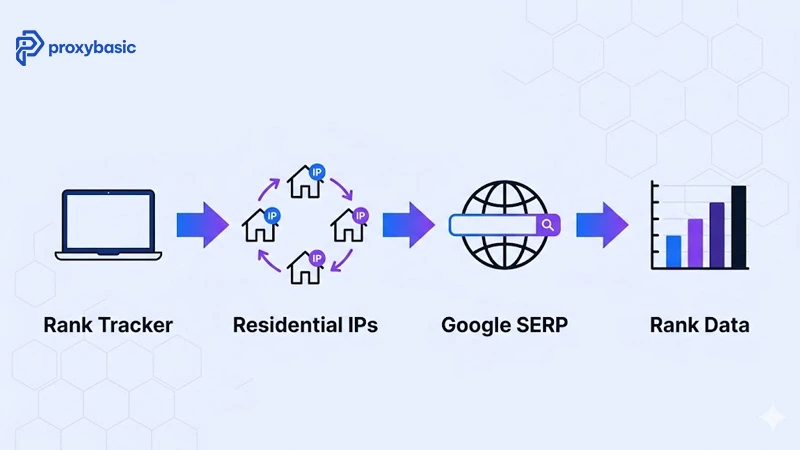
A residential proxy pool distributes that load across thousands or millions of unique IPs. Each IP handles a small fraction of total requests, which keeps individual request density low enough to avoid triggering security systems. The result is a higher success rate on data collection without needing a CAPTCHA-solving layer.
How Residential Proxies Work in a SERP Monitoring Setup
Residential proxies work in a SERP monitoring setup by acting as a gateway layer between your rank tracking tool and the search engine. Every outbound request from your tracker routes through a residential IP in the target location, and the response comes back through that same IP.
The three components that make this work are:
1. IP Pool Size and Diversity A large, diverse pool reduces the chance of any single IP getting flagged. Pools with 10 million or more IPs spread requests across enough nodes that individual IPs rarely hit request limits.
2. Rotation Logic Rotating proxies change the IP on every request or after a set interval. This prevents Google from associating repeated SERP queries with one source. For broad keyword sets, per-request rotation is the standard approach.
3. Sticky Sessions for Multi-Page Crawls When a rank check needs to load page 2 or 3 of results, or navigate from a SERP to a specific listing, the request sequence needs to come from the same IP. Sticky sessions hold one IP for a set duration (typically 1 to 30 minutes) to maintain session continuity without triggering a location jump.
Configuring Residential Proxies with a Python Rank Tracker
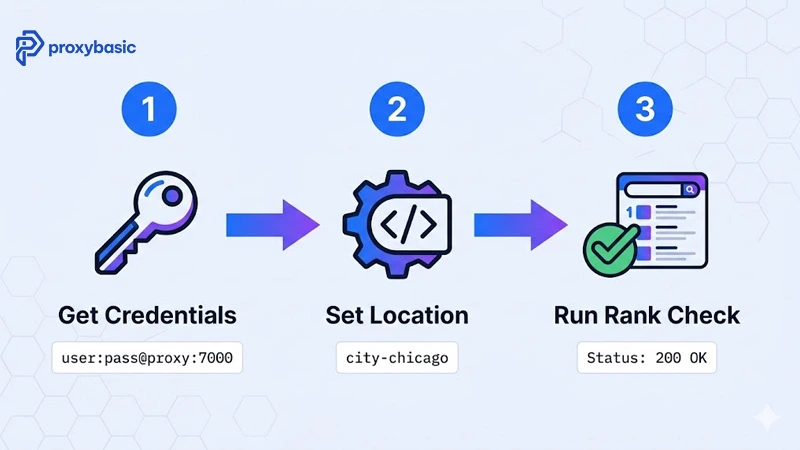
For teams running custom scrapers, a residential proxy gateway integrates through standard HTTP authentication. The key is also setting accurate browser headers alongside the proxy, since Google evaluates both the IP and the request fingerprint.
import requests

proxy_host = "proxy.proxybasic.com"
proxy_port = "7000"
proxy_user = "user-zone-residential-region-us-city-chicago"
proxy_pass = "your_password"

proxy_url = f"http://{proxy_user}:{proxy_pass}@{proxy_host}:{proxy_port}"
proxies = {"http": proxy_url, "https": proxy_url}

headers = {
    "User-Agent": "Mozilla/5.0 (Windows NT 10.0; Win64; x64) AppleWebKit/537.36 (KHTML, like Gecko) Chrome/124.0.0.0 Safari/537.36",
    "Accept-Language": "en-US,en;q=0.9",
}

def check_rank(keyword):
    url = f"https://www.google.com/search?q={keyword.replace(' ', '+')}&gl=us&hl=en"
    response = requests.get(url, proxies=proxies, headers=headers, timeout=15)
    return response.status_code, len(response.text)

status, size = check_rank("residential proxies for SERP monitoring")
print(f"Status: {status} | Response size: {size} chars")
The city-chicago parameter in the username string targets a specific location. Changing that value switches the proxy exit node to a different city without code changes.
Residential vs. Datacenter Proxies for SERP Monitoring
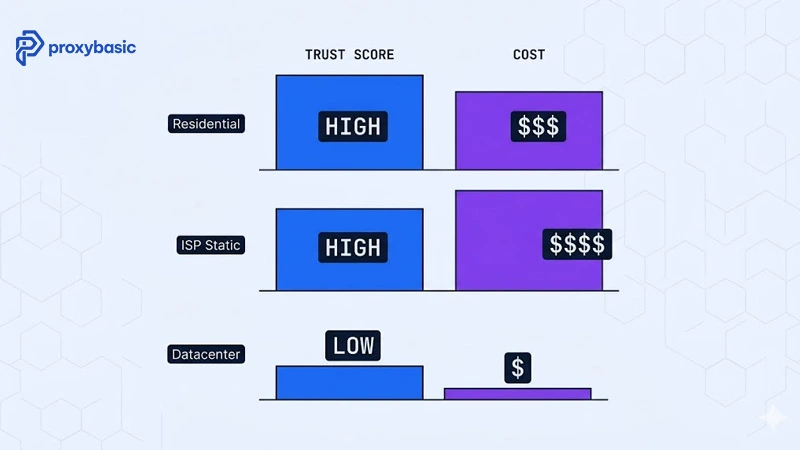
Residential proxies for SERP monitoring win on accuracy and trust score; datacenter proxies win on speed and cost. The right choice depends on whether your priority is data quality or raw throughput.
The SERP data collection proxy comparison below covers the main differences that affect rank tracking workflows. This table helps you match the proxy type to your monitoring requirements before committing to a setup.
| Proxy Type | Trust Score | Local Accuracy | Speed | Cost per GB | Best Use Case |
|---|---|---|---|---|---|
| Residential | High | City/ZIP level | Moderate | $2–$5 | Local SEO, hyper-local SERP audits |
| ISP (Static Residential) | High | Country/State level | Fast | $3–$6 | Long-session tracking, stable crawls |
| Datacenter | Low–Medium | Country level only | Very fast | $0.5–$1 | Non-localized keyword discovery |
For most SEO teams running proxies for SERP monitoring, residential is the default choice when local accuracy matters. ISP proxies work well for stable, long-running sessions where a consistent IP identity improves data continuity. Datacenter proxies fit broad, non-localized keyword sweeps where speed and cost outweigh geographic precision.
When to Use Rotating vs. Sticky Residential Proxies
The choice between rotating and sticky sessions depends on the structure of your SERP check:
- Rotating proxies: One new IP per request. Best for bulk keyword checks across many independent queries where each request is self-contained.
- Sticky proxies: One IP held for a set duration. Best for paginated result collection (page 1 through page 5), or when the rank tracker needs to follow a redirect chain from a SERP listing.
For most rank tracking tool with proxy setups, a rotating residential proxy handles the majority of checks. Sticky sessions are reserved for deep-crawl sequences that need session continuity.
How to Choose the Right Residential Proxy for SERP Monitoring
Choosing the right residential proxy for rank tracking comes down to five factors: pool size, geo-targeting depth, rotation control, session management, and API compatibility with your existing tools.
A small SEO operation checking a few hundred keywords per day has different requirements than an agency running 50,000 daily keyword checks across 20 markets. Here is how to evaluate each factor:
Pool Size Larger pools reduce the chance of IP reuse within a monitoring window. For daily bulk tracking, a pool with at least 10 million residential IPs provides enough diversity to prevent any single IP from appearing more than once per cycle.
Geo-Targeting Depth Country-level targeting is the minimum. For local SEO, you need city-level or ZIP-code targeting. Check whether the provider supports state, city, and postal code parameters in the proxy authentication string.
Rotation Control Some tools need per-request rotation; others need time-based rotation with sticky intervals. Confirm the provider supports both modes via configuration rather than requiring separate product tiers.
Session Management For SERP data collection proxy workflows that involve paginated results or multi-step navigation, sticky session duration matters. Look for providers that allow sticky sessions of 10 to 30 minutes.
API Compatibility If you use a GUI tool like Rank Tracker, Ahrefs, or SEMrush with proxy support, the provider needs to support HTTP/HTTPS proxy authentication via username and password. Most residential proxy providers do, but ISP filtering options and protocol support (SOCKS5 vs. HTTP) vary.
Optimizing Long-Term SERP Monitoring with Residential Proxies
Long-term SERP monitoring with residential proxies requires proxy hygiene as much as it requires pool size. A well-maintained proxy configuration keeps data quality consistent over months of reporting without accumulating errors from dead nodes or rate-limit events.
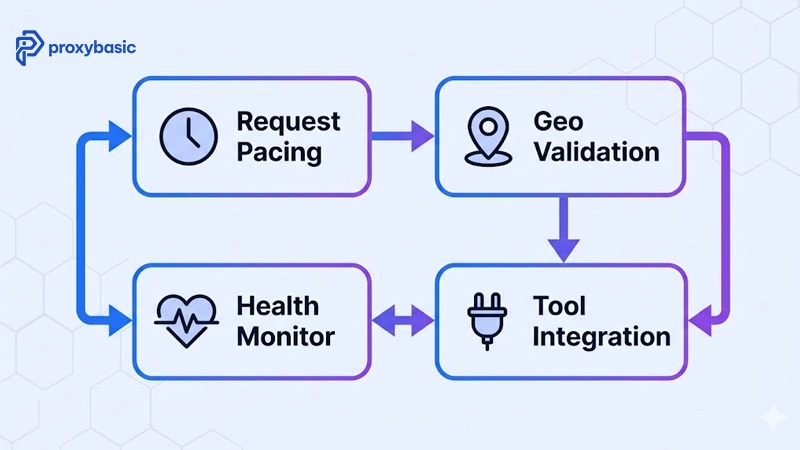
Four practices that extend the reliability of a residential proxy monitoring setup:
Request Pacing Sending all 10,000 daily keyword checks in a single burst looks like a bot pattern even with residential IPs. Spreading checks across a 6 to 12 hour window distributes the load more naturally and reduces the chance of triggering Google’s anomaly detection.
Geo-Targeting Validation Verify periodically that the exit IPs match the target city. Residential proxy pools refresh over time as devices join and leave the network. If a provider’s city-level pool shrinks, requests may exit from a different location than intended.
Health Monitoring Track request success rates by proxy node. A rising error rate on specific IPs signals that those nodes have been flagged. A good residential proxy provider rotates flagged IPs out automatically, but monitoring your own success rate gives you early warning if a pool is degrading.
Tool Integration Match the proxy setup to the tool’s architecture. Custom scrapers benefit from programmatic proxy gateway integration. GUI-based rank trackers work best with a proxy provider that supports the tool’s proxy configuration format directly.
Conclusion
Residential proxies for SERP monitoring are the practical standard for SEO teams that need accurate, location-specific ranking data at scale. They solve the three core problems of direct rank checking: IP bans from high-frequency requests, geographic bias from single-location queries, and CAPTCHA friction from datacenter footprints.
For teams that track local keywords, manage multi-market campaigns, or run large-scale competitor audits, the combination of real residential IPs, city-level geo-targeting, and flexible rotation gives rank tracking workflows a reliable data foundation.
If you are building or upgrading a SERP monitoring setup, visit ProxyBasic to explore residential proxy options with city-level targeting, high-concurrency support, and API-compatible authentication for rank tracking tools.