Residential proxies for price monitoring work by routing scraping requests through real ISP-assigned IP addresses, so e-commerce sites, retail platforms, and competitor pricing pages treat your requests as genuine user traffic. Yes, it works, and it works significantly better than datacenter proxies for price tracking tasks where sites actively block non-human traffic. The three core reasons: residential IPs pass bot detection filters, geo-targeting returns location-accurate prices, and rotating sessions prevent rate-limit bans.
Setting up residential proxies for price tracking requires choosing between rotating and sticky sessions, matching proxy geo to the target market, and pairing the proxy with the right scraping tool. Beyond the basics, JavaScript rendering, browser fingerprinting, and cost-per-GB pricing all affect how well your price monitoring program performs at scale. The sections below break down each factor so you can decide whether residential proxies fit your specific use case.
What Is Price Monitoring with Residential Proxies?
Price monitoring with residential proxy is a method where automated tools use ISP-assigned IP addresses to collect real-time pricing data from competitor sites, retail platforms, and marketplaces without triggering anti-bot systems. Unlike datacenter proxies, residential IPs come from real subscriber connections, which makes them look identical to organic user traffic.
To understand why this matters, it helps to see exactly how the request flow works.
How Do Residential Proxies Work for Price Tracking?
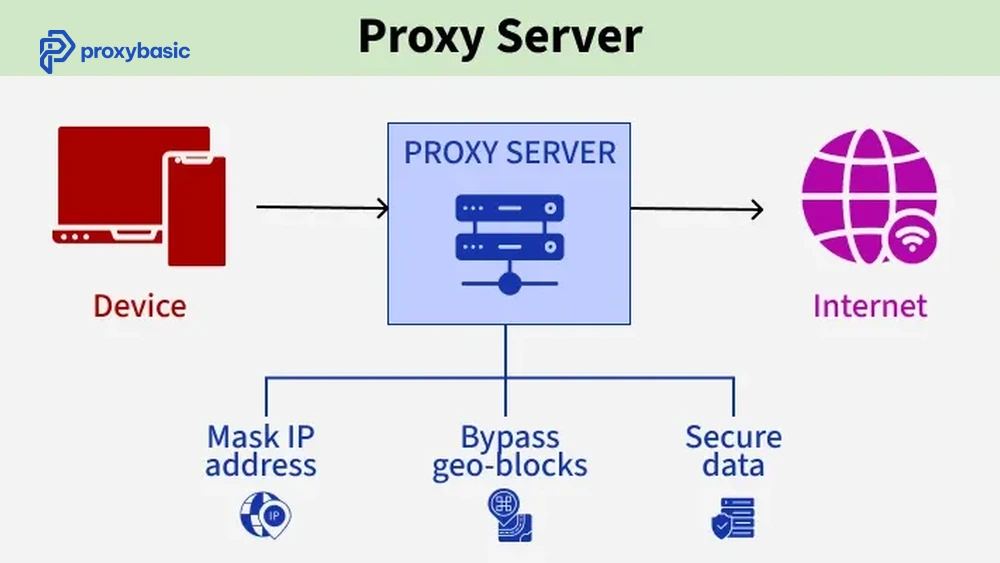
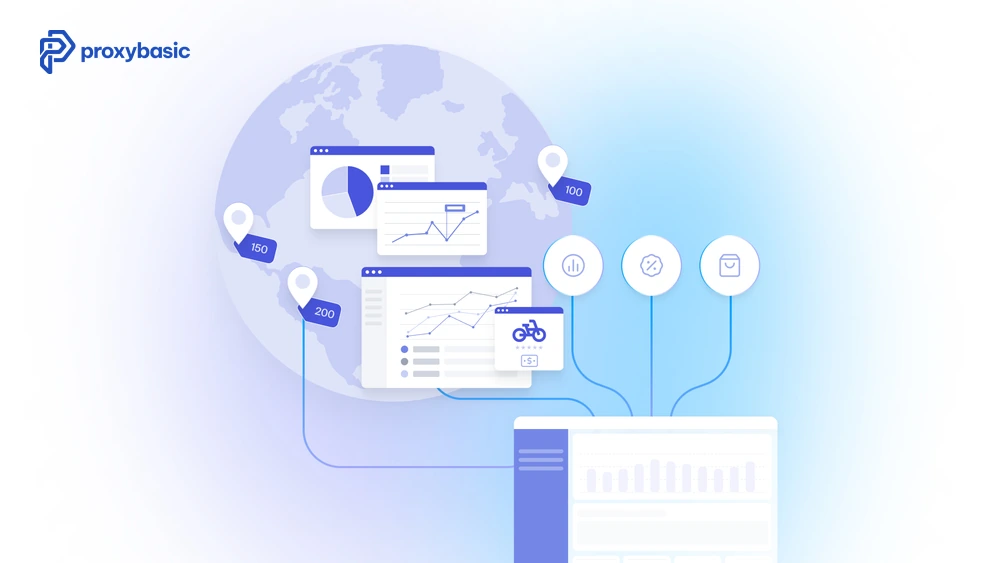
A residential proxy works as a relay: your scraping request exits through a real subscriber IP assigned by an ISP like Comcast, BT, or Telstra. The target site receives a request that looks identical to one from a real shopper in that location. It returns real price data, including geo-specific pricing, personalized discounts, and dynamic price variations data that a datacenter IP would never see because it gets flagged and blocked before reaching the pricing layer.
The key mechanism is IP legitimacy. Residential IPs carry ISP trust scores that datacenter IPs lack entirely. When a site’s bot detection system checks the incoming IP against known datacenter ranges, a residential IP passes clean. A datacenter IP fails immediately.
Why Do Price Monitoring Tools Need Proxies?
Price monitoring tools need proxy for three reasons: e-commerce sites actively block repeated requests from single IPs, geo-targeted pricing requires local IPs to return accurate data, and competitor sites deliberately show different prices to known scrapers.
Without a proxy, a price monitoring tool hits rate limits after 20-50 requests on most major retail sites. With a rotating residential proxy pool, each request comes from a different IP, distributing traffic across thousands of real addresses. This keeps the monitoring program running continuously without triggering blocks or CAPTCHA.
Does Price Monitoring with Residential Proxies Actually Work?
Yes, price monitoring with residential proxies works reliably for most e-commerce and retail use cases, with success rates between 85-95% on major platforms when configured correctly, compared to 30-50% for datacenter proxies on the same targets. The three conditions that determine success are correct geo-targeting, an appropriate session type, and a scraping tool that handles JavaScript rendering.
Below are the specific site categories where residential proxies perform well, and where they hit limits.
What Types of Sites Can You Monitor with Residential Proxies?
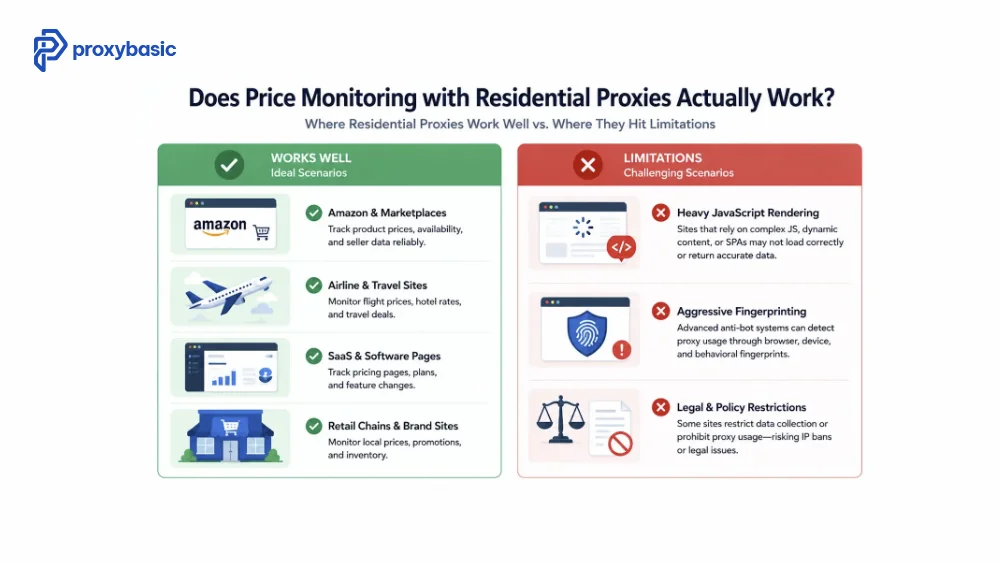
There are four main site categories that residential proxies handle well for price monitoring:
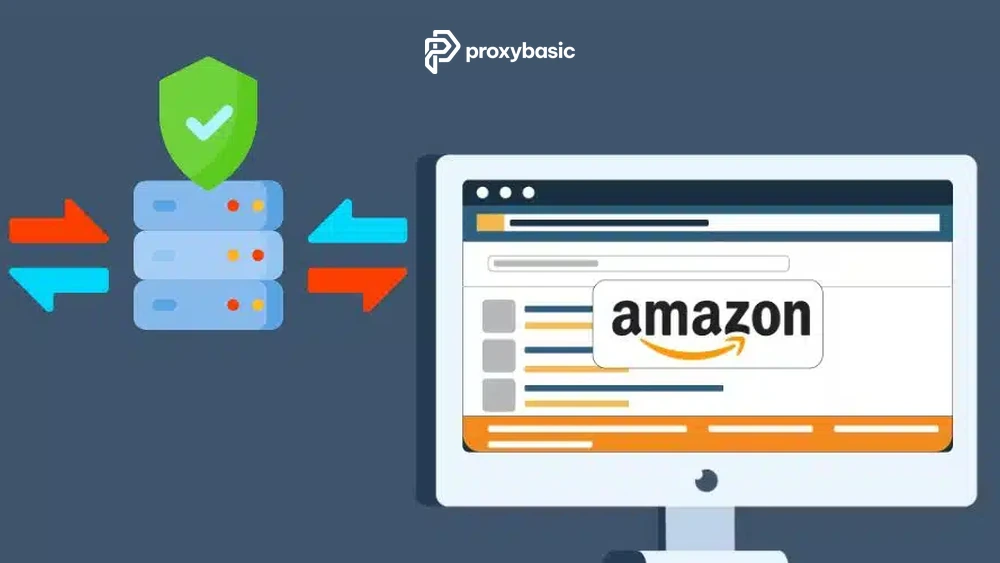
- E-commerce marketplaces (Amazon, eBay, Walmart): residential IPs return real buy-box prices, seller-specific pricing, and geo-based promotions that scrapers using datacenter IPs never see
- Airline and travel pricing: fare data is heavily geo-gated and session-dependent; residential sticky sessions return the same price a real traveler would see
- SaaS and subscription pricing pages: many SaaS sites show different pricing tiers based on location; residential geo-targeting captures the correct regional price
- Retail chain websites: brick-and-mortar retailers increasingly use local pricing; city-level residential proxy targeting returns store-accurate price data
What Are the Limitations of Residential Proxies for Price Monitoring?
No, residential proxies do not solve every price monitoring challenge. Three limitations affect real-world performance:
- JavaScript-rendered pricing: sites that load prices via client-side JS after page load require a headless browser alongside the proxy; the proxy alone returns an empty price field
- Speed vs. accuracy tradeoff: residential proxies are 3-5x slower than datacenter proxies due to routing through real subscriber connections, which increases scraping time at scale
- Cost at high volume: residential proxies are priced per GB, typically $5-15/GB depending on provider; large-scale monitoring programs that scrape millions of SKUs daily can run $500-2,000/month in proxy costs alone
Residential Proxy vs Datacenter Proxy for Price Monitoring: Which Is Better?
Residential proxies win on accuracy and block avoidance for price monitoring; datacenter proxies win on speed and cost for low-protection targets. The decision depends on the specific sites you monitor and the volume you need.
The table below compares both proxy types across the four factors that matter most for price monitoring workflows. Reviewing this comparison before choosing a provider will save significant setup time and budget.
|
Factor |
Residential Proxy |
Datacenter Proxy |
|
Block rate on major retail sites |
5-15% |
50-70% |
|
Speed |
2-5 seconds/request |
0.5-1 second/request |
|
Cost per GB |
$5-15 |
$0.50-2 |
|
Geo-targeting accuracy |
City/ISP level |
Country-level only |
|
Best for |
Amazon, airlines, geo-gated pricing |
Simple sites, internal tools |
When Should You Use Datacenter Proxies Instead?
Yes, datacenter proxies are the better choice in three specific scenarios: when monitoring sites with no bot protection (small retailer sites, public price feeds), when running high-volume scrapes where speed matters more than accuracy, and when budget is the primary constraint and block rates above 30% are acceptable.
For a review-focused workflow where accuracy and trust matter, residential proxies are the right default. Datacenter proxies make sense as a secondary pool for low-risk targets to reduce overall cost.
How to Set Up Residential Proxies for Price Monitoring
Setting up residential proxies for price monitoring is simple if we follow the right steps. With proper setup, we can build a price tracker that keeps block rates below 10% on most major retail sites. Here are the 4 main steps:
- Step 1: Choose a residential proxy provider that supports city-level geo-targeting
- Step 2: Configure the session type based on the target website
- Step 3: Set request headers to match real browser behavior
- Step 4: Test on a small group of products (SKU) before scaling up
The most important part is choosing the right configuration. The two decisions below will have the biggest impact on how accurate and reliable your price monitoring system is.
Rotating vs Sticky Sessions: Which Works Better for Price Tracking?
Rotating sessions work better for large-scale price monitoring across many SKUs; sticky sessions work better for session-dependent pricing like airline fares, cart-based discounts, and loyalty pricing.
Rotating sessions swap IP addresses between requests, which prevents rate limiting when scraping thousands of product pages across a single domain. Sticky sessions hold the same IP for the full browsing session, which lets the site’s pricing engine apply session-based logic the same way a real shopper accumulates a cart and sees personalized prices.
The practical rule: use rotating sessions for catalog-level price scraping, sticky sessions for checkout-level and fare-class pricing.
How to Choose the Right Geo-Location for Price Monitoring
Match proxy geo to the market where prices are set, not where your business operates. A US-based company monitoring UK retail pricing needs UK residential IPs, ideally city-level targeting in the retailer’s primary markets (London, Manchester), to get the prices that real shoppers in those locations see.
Four geo-selection factors for price monitoring:
- Country-level: minimum requirement for any geo-gated pricing
- State/region-level: needed for US retailers with regional pricing programs
- City-level: needed for brick-and-mortar chains with local pricing
- ISP-level: needed for telco and broadband service pricing, which varies by carrier
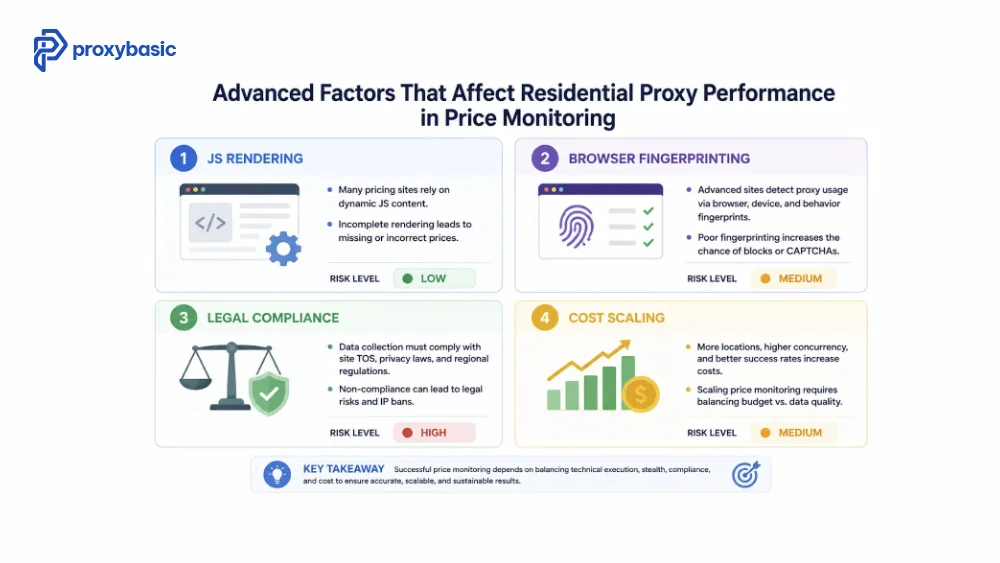
Advanced Factors That Affect Residential Proxy Performance in Price Monitoring
Beyond proxy tier and session type, four technical factors determine whether a residential proxy price monitoring setup performs as expected in production or fails silently with inaccurate data.
Does JavaScript Rendering Affect Price Data Accuracy?
Yes, JavaScript rendering directly affects price data accuracy for any site that loads pricing dynamically after the initial page request. Sites like Amazon, Booking.com, and most SaaS pricing pages inject price values via client-side JavaScript after the HTML skeleton loads. A standard proxy request returns the skeleton without the price.
The fix is pairing your residential proxy with a headless browser like Playwright or Puppeteer. The proxy handles IP legitimacy; the headless browser handles JS execution. Without both, dynamic pricing pages return empty or placeholder price fields that look like valid data but contain no real pricing information.
How Anti-Bot Fingerprinting Bypasses Residential Proxy Anonymity
Browser fingerprinting collects device signals that have nothing to do with IP address: canvas rendering output, WebGL renderer string, installed font list, screen resolution, timezone, and language settings. Sites using advanced anti-bot systems like Akamai Bot Manager or Cloudflare’s bot detection layer check these signals alongside IP reputation.
An elite residential proxy removes the IP-based detection signal. It does not remove the fingerprint signal. A headless browser running default Chromium settings produces a fingerprint that matches no real consumer device, which triggers bot detection even on a clean residential IP. Configuring realistic browser fingerprints matching the OS, browser version, and device profile of users in the target market is the step most price monitoring setups skip, and the reason residential proxies still get blocked on heavily protected sites.
Is Price Scraping with Residential Proxies Legal?
Price scraping with residential proxies sits in a legally complex space that depends on jurisdiction, target site, and data use. Three factors to check before running a monitoring program at scale:
- Terms of service: Most major e-commerce platforms prohibit automated access in their ToS; scraping at scale technically violates these terms regardless of proxy type
- Computer Fraud and Abuse Act (US): Accessing a system in a way the owner prohibits may create CFAA exposure for US-based operations; legal opinions vary on whether ToS violations constitute unauthorized access
- EU data protection: Collecting publicly visible price data generally does not trigger GDPR, but capturing personal data visible in ad targeting or personalized pricing may
The practical step for a review site running price monitoring research: document the public-interest and research purpose, limit data collection to publicly displayed prices, and avoid storing any user-identifying data returned in responses.
How Much Does Residential Proxy Price Monitoring Cost at Scale?
Residential proxy pricing for price monitoring programs follows a GB-based model at most providers, with costs ranging from $5 to $15 per GB depending on provider, geo, and volume tier. A realistic cost breakdown for a mid-scale monitoring operation:
|
Scale |
Daily SKUs |
Est. Data/Day |
Monthly Cost |
|
Small |
1,000 SKUs |
~0.5 GB |
$75-150 |
|
Medium |
50,000 SKUs |
~20 GB |
$600-1,500 |
|
Large |
500,000 SKUs |
~200 GB |
$5,000-15,000 |
Cost scales faster than SKU count because JS-rendered pages transfer significantly more data per request than static HTML. Optimizing request headers to block unnecessary assets (images, fonts, tracking scripts) reduces data consumption by 40-60% on most targets.
Should You Use Residential Proxies for Price Monitoring?
Residential proxies for price monitoring deliver reliable results for e-commerce, retail, airline pricing, and SaaS competitor tracking when configured with the right session type, geo-targeting, and JavaScript handling. The block rate advantage over datacenter proxies is real and significant on any major platform with bot protection. The tradeoff is cost and speed, both of which are manageable with proper request optimization.
For a review site evaluating residential proxy providers for price tracking use cases, proxybasic.com covers provider comparisons, pricing benchmarks, and configuration guides across the top residential proxy networks. Visit to find the right provider for your monitoring volume and target markets.